
WhatsApp Business API Guide for SA Companies
03/06/2026
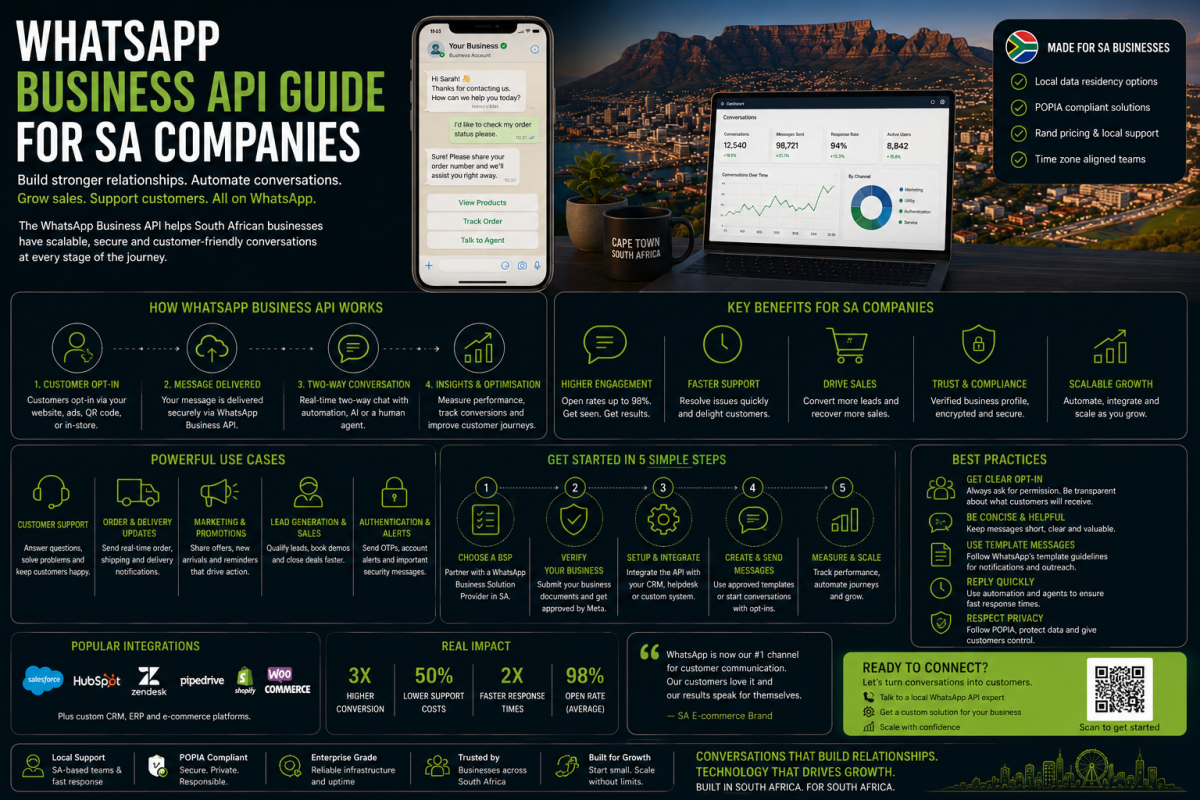
The WhatsApp Business API Blueprint: Turning Conversational Flow into Direct Revenue
The Most Important Business Platform in South Africa Isn't Email
For decades, businesses built their sales and customer service systems around email.
A prospect filled in a form.
The company sent an email.
The customer replied.
A salesperson followed up.
A quote was generated.
Documents were exchanged.
Eventually, if everything went well, a deal was closed.
The problem is that this model increasingly reflects how businesses want customers to behave, not how customers actually behave.
Today's South African consumer lives on mobile.
They browse on mobile.
They communicate on mobile.
They shop on mobile.
They make decisions on mobile.
Most importantly, they spend a significant portion of their day inside WhatsApp.
For many South Africans, WhatsApp is no longer just a messaging application.
It is their communication platform, customer support channel, document-sharing tool, voice calling service, group collaboration system, and increasingly, their preferred way of interacting with businesses.
This creates an enormous opportunity.
While many organisations still treat WhatsApp as a customer support tool, forward-thinking businesses are beginning to use the official WhatsApp Business API as a revenue generation engine.
The companies that understand this shift are discovering something powerful:
The fastest path from inquiry to revenue may no longer be a website form or email sequence.
It may be a WhatsApp conversation.
Why WhatsApp Dominates the South African Market
To understand why WhatsApp matters so much, businesses need to understand the South African context.
South Africa remains a mobile-first market.
Many consumers access the internet primarily through smartphones.
While connectivity continues to improve, data costs still matter.
Consumers often prefer platforms that are familiar, efficient, and already integrated into their daily lives.
WhatsApp meets all of these requirements.
Unlike email, WhatsApp messages are usually seen quickly.
Unlike websites, no additional browser tabs are required.
Unlike traditional contact forms, there is no waiting period before engagement begins.
The conversation starts immediately.
This matters because every delay creates friction.
Every extra step reduces conversion rates.
Every additional form field loses potential customers.
WhatsApp removes many of these barriers.
The Difference Between WhatsApp and the WhatsApp Business API
Many business owners believe they are already using WhatsApp because they have a WhatsApp number.
In reality, there is a major difference between WhatsApp Business and the WhatsApp Business API.
WhatsApp Business App
Most small businesses use:
- Manual messaging
- Manual replies
- Manual follow-ups
- Manual customer management
This works initially.
However, it becomes difficult to scale.
As enquiry volumes increase, response times slow down.
Opportunities are missed.
Leads go cold.
Revenue leaks from the pipeline.
WhatsApp Business API
The API allows businesses to:
- Automate conversations
- Connect to CRM systems
- Generate quotes automatically
- Route leads
- Trigger workflows
- Manage customer journeys
- Integrate with internal systems
Instead of acting as a messaging app, WhatsApp becomes a business operating platform.
This is where the real opportunity begins.
From Conversations to Revenue
Most companies view customer conversations as a support activity.
The best businesses view conversations as a sales process.
Every customer interaction contains information.
Examples include:
- What the customer wants
- Budget expectations
- Service requirements
- Location
- Timeline
- Buying intent
The challenge is capturing and acting on this information efficiently.
The WhatsApp Business API allows companies to transform ordinary conversations into structured business workflows.
Instead of simply answering questions, businesses can:
- Qualify leads
- Generate estimates
- Book appointments
- Collect documents
- Create opportunities
- Close sales
All inside a familiar messaging environment.
Why Email Is Losing Ground
Many businesses still rely heavily on email.
Unfortunately, email introduces multiple problems.
Customers may:
- Miss messages
- Ignore messages
- Delay responses
- Forget to reply
- Lose attachments
A sales cycle that could take hours may take days or weeks.
WhatsApp significantly reduces these delays.
When a prospect requests information, the conversation can continue immediately.
Questions are answered in real time.
Documents can be exchanged instantly.
Next steps happen faster.
This speed directly impacts revenue.
The Western Cape Opportunity
The Western Cape has become one of South Africa's most dynamic business regions.
Industries experiencing growth include:
- Logistics
- Property
- Professional services
- Construction
- Agriculture
- Tourism
- Financial services
Many of these industries still rely heavily on manual enquiry handling.
This creates substantial automation opportunities.
Rather than hiring additional administrative staff, businesses can build WhatsApp-driven revenue systems.
Use Case 1: Logistics Companies
The logistics sector provides one of the clearest examples.
Many freight and transport companies receive large volumes of quote requests every day.
A typical process looks like this:
Customer sends enquiry.
Staff member reviews request.
Staff member gathers information.
Staff member calculates pricing.
Staff member sends quote.
Customer waits.
The process is slow and resource intensive.
Now imagine a WhatsApp API workflow.
Customer sends:
"I need a delivery from Cape Town to George."
The automated system immediately asks:
- Pickup location?
- Delivery location?
- Package dimensions?
- Weight?
- Delivery timeline?
The customer responds.
The system calculates pricing automatically.
A quote is generated instantly.
The lead enters the CRM.
The sales team receives a notification.
The customer receives pricing within minutes.
This dramatically increases conversion potential.
Building Instant Freight Estimators
One of the most effective logistics applications is the automated quote estimator.
The workflow is straightforward.
Step 1
Customer starts a WhatsApp conversation.
Step 2
The system gathers required variables.
Step 3
Pricing rules calculate estimated costs.
Step 4
Quote is generated instantly.
Step 5
Lead is assigned to sales.
Instead of waiting for office hours, prospects receive information immediately.
This improves customer experience while reducing administrative workload.
Use Case 2: Real Estate Syndicates and Property Groups
The property industry often loses leads because response times are too slow.
Potential investors browse listings after hours.
Questions arise immediately.
Many prospects never receive answers until the next business day.
By then, interest may have disappeared.
WhatsApp automation solves this problem.
Instant Property Qualification
Imagine an investor enquires about a property opportunity.
The WhatsApp system can automatically gather:
- Budget range
- Investment goals
- Preferred location
- Financing requirements
- Investment timeline
Based on these responses, the system can:
- Recommend suitable opportunities
- Send brochures
- Schedule consultations
- Collect documentation
- Route leads to advisors
The prospect receives immediate engagement.
The advisory team receives qualified leads.
Automated Investor Onboarding
Real estate syndicates often spend significant time collecting documents.
Typical requirements include:
- Identity verification
- Financial documentation
- Investor questionnaires
- Compliance forms
Through the WhatsApp API, these steps can be automated.
The system requests each document sequentially.
Progress is tracked automatically.
Missing items are identified.
Reminders are sent automatically.
Administrative overhead falls dramatically.
Use Case 3: Professional Services Firms
Law firms, accounting practices, consulting firms, and engineering businesses often face a similar problem.
Their experts spend too much time on administrative intake.
Highly skilled professionals become trapped in repetitive processes.
Automated Client Intake
Imagine a legal practice receiving an enquiry.
Instead of waiting for a receptionist, the client begins an automated intake journey.
The system asks:
- Nature of matter
- Urgency level
- Location
- Required services
- Existing documentation
Relevant information is collected immediately.
The appropriate department receives the enquiry.
Lawyers receive complete context before making contact.
The process becomes significantly more efficient.
Accounting Firms and Tax Practices
Accounting firms often experience seasonal spikes.
During tax periods, enquiries can become overwhelming.
WhatsApp workflows can:
- Gather taxpayer information
- Collect supporting documents
- Schedule consultations
- Track progress
- Answer common questions
Staff focus on advisory work.
Routine administration becomes automated.
The Power of Lead Qualification
One of the most overlooked benefits of WhatsApp automation is lead qualification.
Not every lead deserves equal attention.
Some prospects are highly motivated.
Others are simply exploring options.
AI-powered WhatsApp workflows can identify the difference.
Questions can determine:
- Budget fit
- Service fit
- Timeline
- Urgency
- Geographic suitability
High-quality leads move directly to sales teams.
Lower-priority leads enter nurture sequences.
Resources are allocated more effectively.
Integrating with CRM Systems
The real value emerges when WhatsApp connects to existing business systems.
Modern integrations allow WhatsApp conversations to update:
- Salesforce
- HubSpot
- Zoho
- Microsoft Dynamics
- Pipedrive
- Custom CRM platforms
Information captured during conversations automatically populates records.
Manual data entry disappears.
Teams work from cleaner, more accurate information.
Building Automated Sales Funnels
Traditional sales funnels often involve:
- Website forms
- Email sequences
- Manual follow-ups
WhatsApp enables a different approach.
The conversation itself becomes the funnel.
A prospect can:
- Ask a question
- Receive information
- Complete qualification
- Receive pricing
- Book a meeting
- Submit documents
- Become a customer
All within a single communication channel.
This dramatically reduces friction.
Customer Support Becomes Revenue Support
Many organisations separate support and sales.
Customers do not.
A support conversation often becomes a sales opportunity.
An effective WhatsApp system recognises this.
If a customer asks about:
- Additional services
- Upgrades
- New products
- Expansion opportunities
The workflow can automatically identify sales potential.
Relevant opportunities are routed appropriately.
Support conversations become revenue conversations.
Triage Systems That Save Time
Many enquiries do not require immediate human attention.
Others are highly urgent.
The challenge is identifying which is which.
WhatsApp triage systems solve this problem.
The system automatically classifies requests.
Examples include:
Priority One
Urgent customer issues.
Priority Two
Qualified sales opportunities.
Priority Three
General information requests.
Priority Four
Administrative enquiries.
Each request reaches the correct destination immediately.
Response quality improves.
Operational efficiency improves.
Why Speed Matters More Than Ever
Research consistently shows that faster responses improve conversion rates.
The reality is simple.
Customers contact multiple providers.
The first company to engage effectively often gains an advantage.
If your competitor responds tomorrow and your WhatsApp system responds immediately, who is more likely to win the business?
Speed creates trust.
Speed creates momentum.
Speed creates revenue.
AI and WhatsApp: The Next Evolution
The combination of AI agents and the WhatsApp Business API is particularly powerful.
Instead of simple menu systems, AI can:
- Understand natural language
- Interpret customer intent
- Ask intelligent follow-up questions
- Generate personalised responses
- Route requests dynamically
This creates conversations that feel significantly more natural.
Customers receive faster service.
Businesses achieve greater automation.
Common Mistakes Businesses Make
Many companies approach WhatsApp incorrectly.
Common mistakes include:
Treating It Like Email
WhatsApp conversations should be short, fast, and interactive.
Overcomplicating Flows
Customers want simplicity.
Too many questions reduce engagement.
Ignoring CRM Integration
Without integration, valuable information becomes trapped.
Focusing Only on Support
The greatest opportunity often lies in sales and onboarding.
A Practical Starting Point
Businesses considering WhatsApp automation should start with one process.
Examples include:
- Quote requests
- Lead qualification
- Client onboarding
- Appointment booking
- Support triage
Launch one workflow.
Measure results.
Optimise performance.
Expand gradually.
This approach reduces risk while generating quick wins.
The Future of Business Communication
The shift away from traditional communication channels is already underway.
Customers increasingly expect:
- Immediate responses
- Mobile-first experiences
- Frictionless interactions
- Personalised engagement
Businesses that continue relying exclusively on email and manual processes may find themselves at a disadvantage.
WhatsApp is becoming more than a messaging platform.
It is becoming a business infrastructure layer.
The companies that understand this early can build powerful competitive advantages.
Conclusion
In South Africa's mobile-first economy, WhatsApp has evolved far beyond a communication tool. It has become one of the most important business channels available.
The official WhatsApp Business API allows organisations to transform conversations into structured workflows that generate revenue, qualify leads, onboard customers, and automate routine operations.
For Western Cape logistics companies, it can deliver instant freight quotations. For real estate syndicates, it can automate investor qualification and onboarding. For professional services firms, it can streamline client intake and reduce administrative overhead.
The biggest opportunity is not simply improving customer service.
It is building systems where conversations themselves become operational processes.
Businesses that successfully deploy WhatsApp automation will not just communicate more effectively.
They will sell faster, onboard clients more efficiently, and create scalable revenue engines directly inside the platform their customers already use every day.