
Why UK Agencies Hire Nearshore Devs in Cape Town
14/06/2026
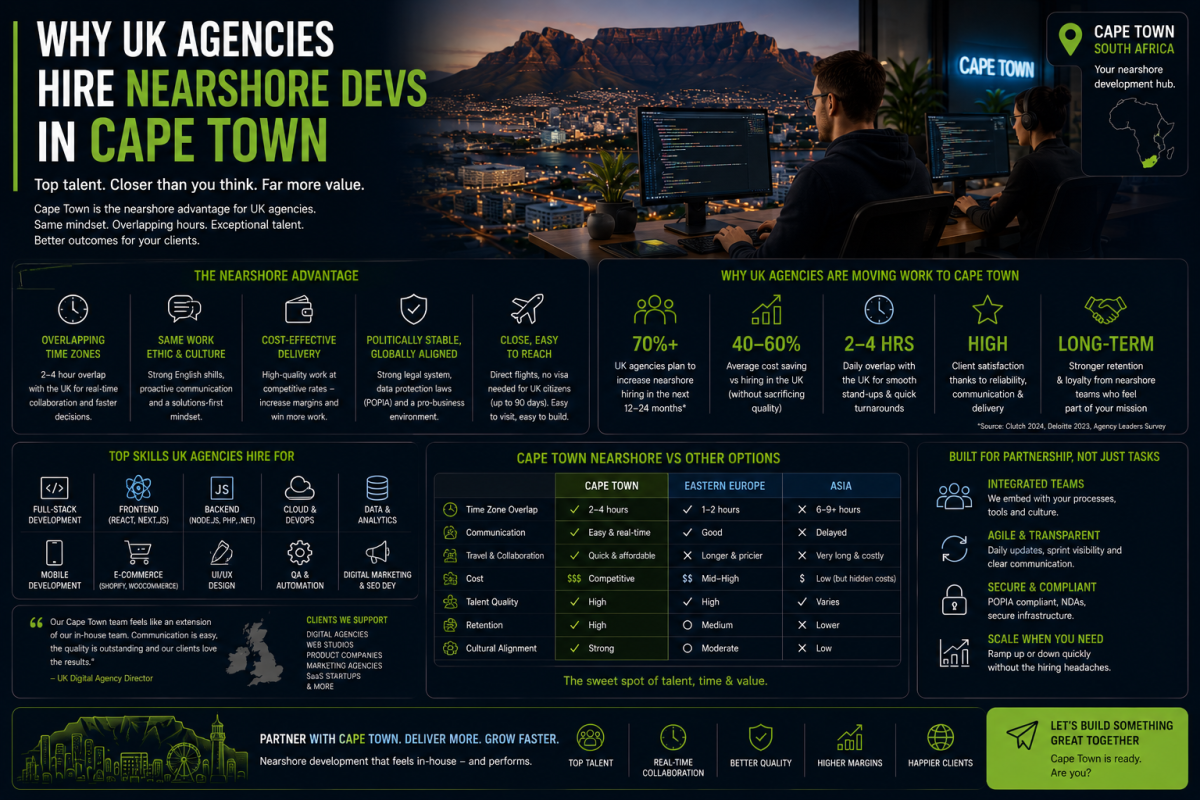
The Nearshore Arbitrage: Why London Agencies Are Moving Engineering Pods to Cape Town
For years, digital agencies across the United Kingdom, Ireland, and Europe followed a relatively predictable growth model.
Win clients.
Hire developers.
Expand delivery teams.
Increase revenue.
Repeat.
The model worked well when talent was readily available and employment costs remained manageable.
Today, that equation is breaking down.
Agency owners increasingly face a combination of challenges that are becoming difficult to ignore:
- Rising salaries
- Developer shortages
- Recruitment delays
- Increased competition for talent
- Margin compression
- Longer project delivery timelines
Many agencies find themselves in a frustrating position.
Sales teams continue winning projects.
Clients continue demanding faster delivery.
Yet building local engineering capacity becomes increasingly expensive and increasingly difficult.
As a result, many agency owners are asking a new question:
"Do we really need every engineer sitting in London, Dublin, Amsterdam, Berlin, or Manchester?"
For a growing number of agencies, the answer is no.
Instead, they are discovering one of the most compelling nearshore opportunities available today:
Cape Town.
What began as a cost-saving strategy has evolved into something much more powerful.
A scalable growth model.
A talent acquisition strategy.
A delivery acceleration framework.
And increasingly, a competitive advantage.
The Agency Margin Squeeze
Agency owners understand the challenge.
Client expectations continue rising.
Budgets remain competitive.
Project complexity increases.
Meanwhile, hiring costs continue climbing.
A senior engineer in London today often costs dramatically more than they did just a few years ago.
The same applies across much of Western Europe.
Beyond salaries, employers must also absorb:
- Recruitment fees
- Benefits
- Pension contributions
- Office costs
- Equipment costs
- Training costs
- Management overhead
The true cost of a developer is often significantly higher than the salary alone.
This creates pressure on agency margins.
Particularly for firms attempting to scale.
The Talent Shortage Problem
Cost is only part of the challenge.
Availability has become equally important.
Many agencies report lengthy recruitment cycles.
Positions remain open for months.
Qualified candidates often receive multiple offers.
Competition for top technical talent is intense.
Even agencies willing to pay premium salaries struggle to fill critical roles.
This creates delivery bottlenecks.
Projects slow down.
Opportunities are delayed.
Growth becomes constrained.
The problem is not demand.
The problem is capacity.
Why Traditional Offshore Models Often Fail
Historically, many agencies attempted to solve these issues through offshore outsourcing.
Common destinations included:
- India
- Eastern Europe
- Southeast Asia
While these models can work, they frequently introduce new challenges.
Examples include:
- Time zone differences
- Communication barriers
- Cultural mismatches
- Project management complexity
- Client-facing limitations
The savings often come with operational friction.
Many agency owners eventually discover that the cheapest option is not always the most effective option.
This is where nearshore strategies become attractive.
Understanding the Nearshore Advantage
Nearshore delivery occupies a middle ground.
It provides meaningful cost savings without introducing many of the challenges associated with traditional offshore models.
Instead of maximising distance, nearshore models optimise alignment.
The goal is not merely reducing costs.
The goal is reducing friction.
This distinction matters.
Because delivery quality often determines long-term profitability.
Why Cape Town Is Emerging as a Nearshore Hub
Cape Town occupies a unique position in the global technology ecosystem.
It combines characteristics that are rarely found together:
- Strong technical talent
- Native English proficiency
- Western business culture
- Time zone compatibility
- Competitive operating costs
- Modern infrastructure
These factors create a highly attractive environment for international agencies.
Especially those serving clients in the UK and Europe.
The Time Zone Advantage
One of the biggest challenges in distributed teams is coordination.
Meetings become difficult.
Approvals slow down.
Communication delays increase.
Cape Town largely avoids these issues.
The city operates in a highly compatible time zone for European businesses.
Working hours overlap extensively with:
- London
- Dublin
- Amsterdam
- Brussels
- Paris
- Berlin
- Madrid
Teams collaborate in real time.
Conversations happen immediately.
Problems get resolved quickly.
This dramatically improves delivery efficiency.
Real-Time Collaboration Matters
Many agency workflows require rapid communication.
Examples include:
- Sprint planning
- Design reviews
- Client workshops
- Technical discussions
- Quality assurance reviews
When teams operate across large time differences, progress slows.
Questions remain unanswered.
Tasks become blocked.
Decisions get delayed.
Nearshore collaboration eliminates much of this friction.
The result is faster execution.
English Fluency Is a Strategic Asset
Technical capability is important.
Communication is equally important.
Many international agencies underestimate how much project success depends on language.
Developers increasingly participate in:
- Client meetings
- Discovery workshops
- Technical presentations
- Product discussions
Clear communication improves outcomes.
South Africa offers a significant advantage here.
English is deeply embedded within business, education, and professional environments.
This reduces misunderstandings.
It improves collaboration.
And it strengthens client confidence.
Cultural Compatibility Is Often Overlooked
Agency owners frequently focus on salaries and technical skills.
They often underestimate the value of cultural alignment.
Successful projects require shared expectations regarding:
- Communication
- Accountability
- Deadlines
- Quality standards
- Problem solving
Cape Town's business culture aligns naturally with many Western organisations.
Professional norms often feel familiar to UK and European clients.
This reduces operational friction.
And friction is expensive.
The Cost Difference Is Significant
Ultimately, economics matter.
The nearshore model must make financial sense.
This is where Cape Town becomes particularly compelling.
Many agencies discover that engineering costs can be substantially lower than equivalent hires in major European markets.
Depending on role, experience level, and structure, operational savings can often be considerable compared to local hiring costs.
These savings create flexibility.
Agencies can:
- Improve margins
- Expand delivery capacity
- Increase competitiveness
- Invest in growth
Without sacrificing quality.
Understanding the Real Cost Equation
Many businesses compare salaries alone.
This is a mistake.
The real cost of employment includes:
- Recruitment
- Benefits
- Taxes
- Office space
- Equipment
- Management
- Turnover risk
When evaluated holistically, the economics become even more compelling.
The difference extends beyond payroll.
It affects the entire operating model.
Building Engineering Pods Instead of Individual Hires
Leading agencies increasingly move away from hiring isolated individuals.
Instead, they establish engineering pods.
A pod typically includes:
- Developers
- Quality assurance specialists
- Technical leads
- Product support roles
The team operates as a cohesive delivery unit.
This model improves:
- Accountability
- Communication
- Velocity
- Scalability
Pods become extensions of existing agency teams.
Not external suppliers.
Why Pods Scale Better
Individual hires solve individual problems.
Pods solve delivery problems.
When agencies win larger contracts, they need coordinated execution.
A pod structure provides:
- Shared processes
- Shared knowledge
- Shared accountability
This creates a more sustainable growth model.
Especially for agencies scaling rapidly.
Faster Delivery Creates Competitive Advantages
The greatest benefit often isn't cost.
It is speed.
Additional engineering capacity enables:
- Faster launches
- Shorter development cycles
- Higher throughput
- More experimentation
Clients notice these improvements.
Projects move faster.
Results arrive sooner.
Agency reputation strengthens.
Growth accelerates.
Client Expectations Are Changing
Modern clients expect rapid delivery.
They compare agencies against:
- Startups
- SaaS companies
- Global technology firms
Long timelines are increasingly difficult to justify.
Agencies need delivery models capable of matching these expectations.
Nearshore engineering capacity helps achieve that goal.
The Rise of Embedded Teams
Clients increasingly prefer continuity.
They want consistent teams.
Consistent communication.
Consistent delivery.
Nearshore pods support this model effectively.
Engineers become familiar with:
- Client systems
- Business processes
- Technical environments
- Strategic objectives
Knowledge accumulates over time.
Delivery quality improves.
Access to High-Quality Technical Talent
Cape Town has developed one of Africa's strongest technology ecosystems.
The city continues attracting:
- Software engineers
- Product specialists
- Designers
- Data professionals
- Cloud architects
This concentration of talent creates opportunities for international agencies seeking scalable delivery capacity.
The talent exists.
The challenge is accessing it efficiently.
Why Recruitment Speed Matters
Winning new business is exciting.
Failing to staff projects is not.
Many agencies encounter situations where:
- Projects are signed
- Clients are ready
- Work is approved
But delivery capacity does not exist.
This creates stress across the organisation.
Nearshore partnerships can significantly reduce recruitment bottlenecks.
Capacity becomes more accessible.
Growth becomes easier to sustain.
Quality No Longer Requires Geographic Proximity
Historically, businesses assumed quality required local teams.
Modern collaboration tools have changed this reality.
Today's teams work through:
- Video conferencing
- Cloud platforms
- Project management systems
- Shared development environments
The quality of collaboration depends far more on process than geography.
And the best nearshore teams integrate seamlessly into existing workflows.
Why Agencies Are Rethinking Their Cost Structures
Economic conditions continue putting pressure on agencies.
Clients demand value.
Competition remains intense.
Profitability matters.
Agency owners increasingly recognise that cost structures designed for the previous decade may not remain sustainable.
Nearshore delivery creates opportunities to modernise operations without compromising service quality.
Beyond Cost Savings
The most successful agencies do not adopt nearshore models solely to save money.
They adopt them to gain leverage.
Additional capacity enables:
- More client work
- Larger projects
- Faster delivery
- Greater innovation
The financial savings become a secondary benefit.
The real advantage is scalability.
Why Cape Town Continues Gaining Momentum
Several factors continue strengthening Cape Town's position.
These include:
- Growing technology ecosystems
- Strong educational institutions
- International business exposure
- Increasing cloud adoption
- Expanding startup activity
The city has evolved beyond an outsourcing destination.
It has become a serious technology hub.
International agencies are taking notice.
The Future of Agency Delivery Models
The traditional model of concentrating every employee in a single city is becoming less common.
Distributed teams are becoming normal.
Nearshore engineering pods are becoming normal.
Global collaboration is becoming normal.
The agencies that adapt earliest often gain significant advantages.
Those that resist may struggle to remain competitive.
The Potado Approach
At Potado, we believe modern agency growth requires more than simply adding headcount.
It requires building scalable delivery systems.
Our Cape Town-based engineering teams are designed to integrate seamlessly with agencies across the UK, Ireland, and Europe, providing the technical capacity needed to accelerate delivery while maintaining quality, communication, and accountability.
By combining strong technical expertise, native English communication, timezone alignment, modern engineering practices, and highly competitive operating structures, we help agencies expand their delivery capabilities without the challenges often associated with traditional offshore models.
The objective is simple:
Enable agencies to scale faster.
Deliver projects sooner.
Improve margins.
And compete more effectively in increasingly demanding markets.
Conclusion
The economics of agency growth are changing.
Across the UK, Ireland, and Europe, rising employment costs, talent shortages, and increasing delivery expectations are forcing agency owners to rethink traditional hiring models.
Nearshore engineering pods provide a compelling alternative.
Cape Town offers a rare combination of advantages that are difficult to find elsewhere: strong technical talent, native English fluency, extensive working-hour overlap with European markets, cultural compatibility, modern infrastructure, and significantly lower operating costs than many Western European locations.
The result is not simply a cheaper workforce.
It is a more scalable delivery model.
Agencies gain access to experienced engineering teams, faster recruitment cycles, increased project capacity, stronger margins, and improved operational flexibility.
In a market where talent shortages continue growing and clients expect faster delivery than ever before, these advantages are becoming increasingly difficult to ignore.
For many agencies, the question is no longer whether nearshore delivery makes sense.
The question is how long they can afford to wait before their competitors move first.