
Tech Outsourcing Driving Cape Town Economic Growth
15/06/2026
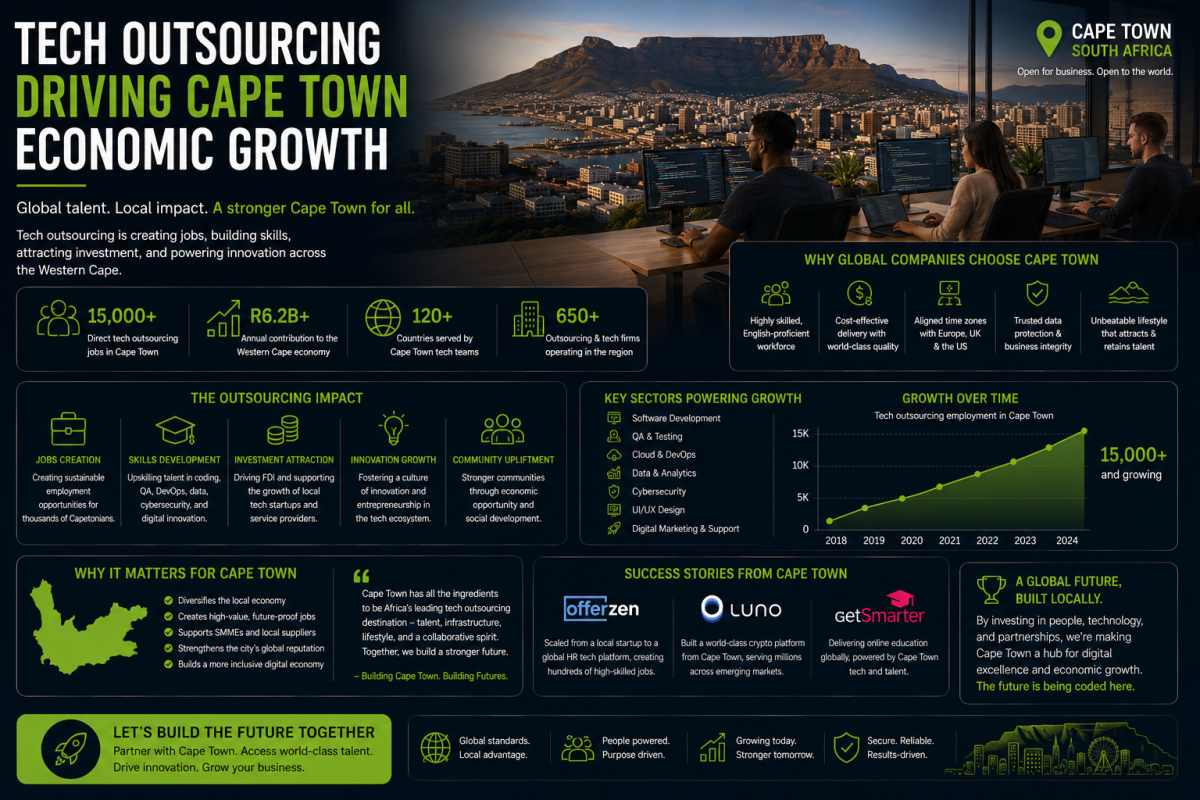
Digital Transformation and Sustainable Local Growth: The Real Cape Town Moat
When most businesses think about outsourcing, the conversation usually begins with cost.
Questions often sound like this:
- Can we reduce expenses?
- Can we hire talent more efficiently?
- Can we scale delivery faster?
- Can we improve margins?
These are valid questions.
Business leaders have a responsibility to allocate resources wisely.
However, something interesting is happening in the global technology industry.
The most successful outsourcing relationships are increasingly being built on something much bigger than cost reduction.
They are being built on shared growth.
Shared capability.
Shared innovation.
And shared long-term value creation.
As companies across Europe, the United Kingdom, North America, and other developed markets search for reliable technology partners, they are discovering that certain regions offer more than operational efficiency.
They offer ecosystems.
They offer talent pipelines.
They offer innovation clusters.
They offer sustainable growth environments.
Cape Town is increasingly becoming one of those places.
What began as a growing technology hub has evolved into something much more significant.
A globally connected digital economy.
A center for advanced technical talent.
A launchpad for international technology partnerships.
And perhaps most importantly, a city where global digital transformation is creating meaningful local economic development.
This combination may ultimately become Cape Town's strongest competitive advantage.
Its real moat.
The Changing Nature of Outsourcing
Historically, outsourcing often followed a simple logic.
A company in a developed market sought lower costs elsewhere.
Work was transferred.
Savings were achieved.
The relationship remained largely transactional.
While this model still exists, it increasingly represents an older way of thinking.
Today's most successful companies are searching for something different.
They are searching for strategic partners.
They want:
- Technical excellence
- Long-term stability
- Innovation capacity
- Cultural alignment
- Talent depth
The objective is no longer simply reducing expenses.
The objective is creating competitive advantages.
This distinction changes everything.
Why Talent Is Becoming the World's Most Valuable Resource
Across the global economy, one challenge continues appearing again and again.
Talent shortages.
Technology companies struggle to hire engineers.
Consultancies struggle to hire specialists.
Agencies struggle to hire developers.
Enterprises struggle to hire data professionals.
The problem is not demand.
Demand continues growing.
The problem is supply.
Highly skilled digital talent remains scarce.
And as artificial intelligence, cloud computing, cybersecurity, automation, and analytics continue expanding, this scarcity is likely to intensify.
The regions capable of developing and retaining digital talent will enjoy significant advantages.
Cape Town is positioning itself as one of those regions.
Digital Transformation Creates New Opportunities
Every industry is becoming more digital.
Banks are becoming technology companies.
Retailers are becoming technology companies.
Logistics providers are becoming technology companies.
Healthcare organisations are becoming technology companies.
The result is a dramatic increase in demand for:
- Software engineers
- Cloud architects
- Data analysts
- Product managers
- UX designers
- Automation specialists
- AI engineers
This demand creates opportunities not only for businesses but also for entire cities and regions.
Cape Town has been one of the primary beneficiaries of this trend.
The Rise of Cape Town's Technology Ecosystem
Cape Town's technology sector has matured significantly over the past decade.
The city now supports:
- Startups
- Scale-ups
- Enterprise technology teams
- Digital agencies
- Product companies
- Software consultancies
This creates a powerful ecosystem effect.
Experienced professionals train new professionals.
Knowledge circulates.
Communities grow.
Standards improve.
The ecosystem strengthens itself.
Over time, this becomes difficult for competitors to replicate.
Why Ecosystems Matter More Than Individual Companies
Many businesses focus on evaluating individual vendors.
Increasingly, they should evaluate ecosystems.
A strong ecosystem creates advantages including:
- Talent availability
- Knowledge sharing
- Professional development
- Innovation capacity
- Recruitment resilience
When companies operate inside thriving ecosystems, they gain access to resources far beyond their own internal teams.
Cape Town's growing technology community provides exactly this benefit.
Closing the Digital Skills Gap
One of the most important effects of international technology investment is skills development.
Every major technology project creates learning opportunities.
Engineers gain exposure to:
- New platforms
- New industries
- New methodologies
- New technologies
- New business challenges
Over time, these experiences compound.
The local talent base becomes stronger.
The skills gap narrows.
The ecosystem becomes more sophisticated.
This creates a virtuous cycle.
How Global Projects Accelerate Local Capability
Consider a developer working on:
- A European fintech platform
- A UK healthcare application
- A North American logistics system
- An international SaaS platform
The knowledge gained from these projects remains within the local ecosystem.
Skills improve.
Standards improve.
Future projects benefit.
The impact extends far beyond a single company.
Entire communities become more capable.
Why High-Value Employment Matters
Not all job creation is equal.
Technology employment often creates particularly powerful economic effects.
High-value digital roles typically generate:
- Strong career progression
- Continuous learning
- Global exposure
- Higher income potential
These benefits extend beyond individual employees.
They influence families.
Communities.
Education systems.
And broader economic development.
The Multiplier Effect of Technology Jobs
Every technology role creates indirect benefits throughout the economy.
Engineers spend money locally.
Businesses purchase services locally.
Office spaces support local industries.
Professional services expand.
New companies emerge.
Economic activity increases.
Technology employment often produces multiplier effects that extend well beyond the technology sector itself.
This is one reason digital economies have become so strategically important.
Why Global Companies Are Looking Beyond Traditional Markets
Historically, many businesses concentrated their outsourcing activities in a small number of regions.
Today, decision-makers increasingly seek alternatives.
They want locations offering:
- Stability
- Talent quality
- Cultural compatibility
- Timezone alignment
- Strong communication
Cape Town performs remarkably well across these criteria.
The city occupies a unique position between developed and emerging markets.
This creates attractive opportunities for international organisations.
The Cape Town Advantage
Several factors contribute to Cape Town's growing appeal.
These include:
English Fluency
Communication remains one of the strongest differentiators in global services.
Cultural Alignment
Business practices often align closely with Western markets.
Time Zone Compatibility
Collaboration with Europe is highly efficient.
Technical Talent
The city continues producing strong engineering and digital professionals.
Quality of Life
Cape Town attracts and retains talent effectively.
Together, these factors create a compelling proposition.
Digital Transformation Is No Longer Optional
Businesses around the world face increasing pressure to modernise.
Customers expect:
- Digital experiences
- Faster services
- Seamless interactions
- Data-driven products
Organisations unable to adapt risk losing competitiveness.
This creates enormous demand for technology services.
The companies capable of meeting this demand become valuable strategic partners.
Why Corporate Buyers Are Becoming More Purpose-Driven
A growing number of enterprises now evaluate suppliers through a broader lens.
Questions increasingly include:
- Does this partnership create positive outcomes?
- Does it support skills development?
- Does it contribute to sustainable growth?
- Does it align with our corporate values?
The most forward-thinking organisations recognise that supplier relationships can create positive economic impact while simultaneously delivering strong commercial results.
These objectives are not mutually exclusive.
They often reinforce each other.
Sustainable Growth Creates Better Outcomes
Short-term optimisation often focuses exclusively on cost.
Long-term optimisation focuses on sustainability.
The strongest partnerships create benefits for all participants.
Clients gain:
- Quality delivery
- Reliable execution
- Innovation capacity
Service providers gain:
- Stable growth
- Talent development
- Long-term opportunities
Communities gain:
- Employment
- Skills development
- Economic activity
This creates stronger outcomes for everyone involved.
Why Skills Development Becomes a Competitive Moat
Technology changes rapidly.
The companies that continuously learn outperform those that do not.
The same principle applies to cities.
A city capable of continuously developing advanced digital skills becomes increasingly attractive.
Talent attracts investment.
Investment develops talent.
The cycle reinforces itself.
This is one of the strongest competitive advantages a technology ecosystem can build.
The Importance of Knowledge Transfer
International partnerships create more than revenue.
They create knowledge transfer.
Teams gain exposure to:
- Global best practices
- Advanced technologies
- Enterprise processes
- Industry-specific expertise
This knowledge remains within the local ecosystem.
Over time, it raises overall capability levels.
The result is stronger long-term competitiveness.
Building the Technology Services Capital of Africa
Cape Town's ambition extends beyond serving as an outsourcing destination.
The city increasingly positions itself as a technology services hub.
A place where:
- Products are built
- Innovations are developed
- Skills are cultivated
- Global partnerships are formed
This evolution is important.
It shifts the conversation from labour arbitrage to value creation.
And value creation is far more sustainable.
Why Businesses Benefit from Strong Ecosystems
Clients often underestimate the advantages of working with organisations embedded within thriving ecosystems.
Strong ecosystems create:
- Better recruitment
- Faster problem-solving
- Greater innovation
- More resilient delivery
A company operating within a strong technology cluster gains access to these advantages automatically.
This improves outcomes for clients.
The Next Phase of Global Technology Services
The future of global services will likely look different from the past.
Success will depend less on finding the cheapest provider.
It will depend more on finding the most capable ecosystem.
Businesses increasingly value:
- Talent quality
- Innovation
- Resilience
- Strategic alignment
Regions capable of delivering these qualities will continue attracting investment.
Cape Town is increasingly positioned to benefit from this shift.
Why Purpose and Performance Can Coexist
There is a persistent misconception that businesses must choose between commercial success and positive impact.
The reality is often the opposite.
The strongest long-term outcomes emerge when commercial and social objectives reinforce each other.
Technology partnerships that:
- Create jobs
- Develop skills
- Build capability
- Deliver excellent results
often generate stronger and more sustainable value than purely transactional relationships.
The Potado Perspective
At Potado, we believe technology partnerships should create value beyond project delivery.
While technical excellence, speed, and execution remain essential, the most successful digital transformation initiatives also contribute to capability development, knowledge transfer, and long-term ecosystem growth.
Every successful project creates opportunities to develop talent, strengthen technical expertise, and expand the digital capabilities that make Cape Town increasingly competitive on the global stage.
Our goal is simple:
Deliver world-class outcomes for clients while helping strengthen the technology ecosystem that enables those outcomes in the first place.
Because sustainable growth is rarely achieved through extraction.
It is achieved through investment.
Why This Matters for International Enterprises
For global organisations, supplier decisions increasingly influence broader strategic objectives.
The right technology partner can provide:
- Elite execution
- Reliable delivery
- Innovation capacity
- Operational flexibility
At the same time, those partnerships can contribute to meaningful economic development and skills creation in emerging technology ecosystems.
This creates a rare alignment.
Businesses achieve commercial objectives while supporting sustainable growth.
Few opportunities offer both simultaneously.
Conclusion
Digital transformation is reshaping industries, economies, and labour markets around the world. As demand for technical talent continues growing, the regions capable of developing, attracting, and retaining digital expertise will become increasingly important.
Cape Town has emerged as one of those regions.
Its growing technology ecosystem, strong talent base, global connectivity, English-language fluency, and expanding international partnerships have positioned it as a leading technology services destination not only in South Africa but across the African continent.
What makes this opportunity particularly compelling is that it extends beyond cost efficiency or outsourcing alone. Global technology partnerships are helping create high-value employment, accelerate skills development, strengthen local capabilities, and build long-term economic resilience.
For international enterprises seeking world-class execution, Cape Town offers access to exceptional technical talent and mature delivery capabilities.
For organisations that also care about sustainable growth and meaningful economic impact, it offers something even more valuable.
The opportunity to participate in building one of the most dynamic technology ecosystems in the world.
And over time, that ecosystem may prove to be Cape Town's strongest and most defensible competitive advantage of all.