
Server-Side Tracking Guide for SA E-Commerce
13/06/2026
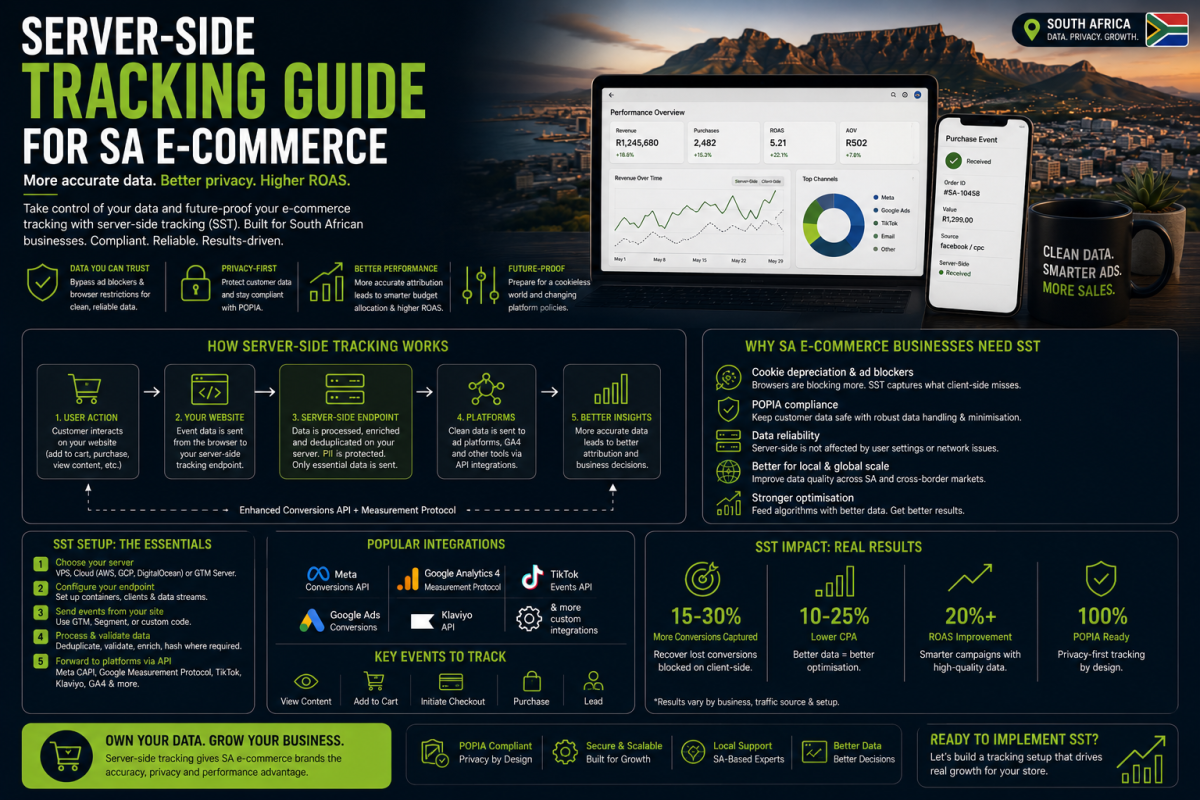
Rescuing Your Ad Spend: Implementing Privacy-First Server-Side Tracking
For years, digital advertising followed a relatively simple formula.
A business launched a campaign.
A visitor clicked an ad.
A tracking pixel recorded the visit.
The customer completed a purchase or submitted an enquiry.
The advertising platform received the conversion data.
Everyone knew what worked.
Everyone knew what didn't.
Marketing teams could confidently answer questions like:
- Which campaign generated the lead?
- Which ad produced the sale?
- Which audience converted best?
- Which channel delivered the highest return on investment?
That world is rapidly disappearing.
Today, many businesses are unknowingly making important marketing decisions using incomplete data.
Advertising platforms increasingly struggle to see what actually happens after users click on ads.
As a result, companies often believe campaigns are underperforming when they are not.
They pause profitable campaigns.
They increase budgets in the wrong places.
They miscalculate return on investment.
And they waste money.
The cause of this problem is not poor advertising.
The cause is broken tracking.
More specifically, traditional browser-based tracking is becoming increasingly unreliable.
This is why businesses around the world are migrating toward privacy-first server-side tracking.
For organisations investing in Meta, Google Ads, LinkedIn, TikTok, or other digital advertising platforms, this shift is becoming less of an advantage and more of a necessity.
The Hidden Crisis in Digital Advertising
Many businesses still assume their analytics platforms provide a complete picture of performance.
Unfortunately, that assumption is becoming increasingly dangerous.
A growing number of customer interactions are never recorded accurately.
Marketing dashboards often tell only part of the story.
Imagine spending:
- R20,000 per month
- R50,000 per month
- R100,000 per month
- Or even more
on digital advertising.
Now imagine losing visibility into a meaningful percentage of conversions.
That is exactly what is happening in many advertising accounts today.
The result is distorted decision-making.
And distorted decision-making is expensive.
How Traditional Tracking Works
Historically, digital marketing relied heavily on browser-based tracking.
The process looked like this:
- User clicks advertisement
- User visits website
- Browser loads tracking pixel
- Pixel sends information to advertising platform
- Platform records activity
- Conversion gets attributed
This system worked remarkably well for many years.
The browser acted as the messenger.
The advertising platform received information directly.
Attribution remained relatively accurate.
Today, however, browsers have become much more restrictive.
Why Browsers No Longer Cooperate
Technology companies have introduced increasingly aggressive privacy protections.
Major browsers now restrict:
- Third-party cookies
- Tracking scripts
- Cross-site identifiers
- Advertising signals
Operating systems have implemented similar restrictions.
Mobile devices increasingly limit data sharing.
Users can opt out of tracking.
Browsers block requests automatically.
Tracking pixels are frequently prevented from functioning correctly.
The result is simple.
Advertising platforms receive less data.
Less data creates less accurate reporting.
The Apple Effect
One of the biggest changes came from mobile privacy initiatives.
Apple's privacy updates dramatically changed how tracking operates across many devices.
Users gained significantly greater control over tracking permissions.
Many chose to limit tracking.
From a privacy perspective, this is understandable.
From an advertising perspective, it created substantial attribution challenges.
Businesses suddenly discovered that conversions appeared to decline.
In many cases, the sales still occurred.
The tracking simply disappeared.
Why Meta and Google Struggle With Missing Data
Advertising platforms optimise based on feedback.
The more accurate the feedback, the better the optimisation.
Consider a simple example.
A campaign generates 100 actual enquiries.
Traditional browser tracking records only 65.
Meta or Google now believes:
"This campaign generated 65 enquiries."
Instead of:
"This campaign generated 100 enquiries."
That missing information affects everything.
Including:
- Audience targeting
- Bid strategies
- Budget allocation
- Conversion optimisation
Incomplete data produces incomplete optimisation.
The Cost of Attribution Blindness
Most businesses focus on ad spend.
Far fewer focus on measurement quality.
Yet measurement quality often determines whether ad spend is effective.
Imagine driving through Cape Town at night.
Now imagine removing half the headlights.
You can still drive.
But your visibility decreases dramatically.
That is essentially what happens when tracking quality deteriorates.
Marketing teams continue spending money.
They simply see less of what is actually happening.
What Is Server-Side Tracking?
Server-side tracking changes where data processing occurs.
Instead of relying entirely on browsers, tracking moves through secure server infrastructure.
Traditional tracking path:
User → Browser → Advertising Platform
Server-side tracking path:
User → Website → Secure Server → Advertising Platform
This creates a much more reliable data pipeline.
Because the browser is no longer responsible for transmitting all critical information.
Why Server-Side Tracking Works Better
The browser is increasingly becoming an unreliable intermediary.
Privacy restrictions interrupt communication.
Ad blockers interfere.
Cookies expire.
Scripts fail.
Server-side tracking reduces these issues significantly.
Because data moves through controlled infrastructure rather than relying exclusively on browser behaviour.
The result is stronger attribution quality.
Understanding Server-Side Tagging
One of the most popular implementations involves server-side tagging.
Instead of sending tracking events directly from a browser to advertising platforms, events are routed through a dedicated server environment.
This environment can:
- Validate events
- Clean data
- Apply privacy controls
- Standardise information
- Forward data securely
The process becomes more reliable and more controllable.
Cloud-Based Tracking Infrastructure
Modern implementations frequently use cloud infrastructure.
This provides several advantages.
Businesses gain:
- Scalability
- Reliability
- Security
- Performance
- Centralised management
Cloud-based tracking servers act as trusted intermediaries between websites and advertising platforms.
The result is cleaner measurement and improved attribution.
The Meta Conversion Advantage
Meta's advertising ecosystem increasingly benefits from server-side event transmission.
Many businesses still rely exclusively on browser-based pixels.
This creates gaps.
Server-side implementations help restore visibility.
Important events such as:
- Lead submissions
- Purchases
- Bookings
- Registrations
- Quote requests
can be transmitted more reliably.
Meta receives better information.
Campaign optimisation improves.
Why Google Ads Benefits Too
Google faces many of the same attribution challenges.
Server-side implementations improve the reliability of:
- Conversion tracking
- Lead tracking
- E-commerce tracking
- Enhanced conversions
- Campaign optimisation
The advertising platform receives stronger signals.
The optimisation engine becomes more effective.
Campaign performance often improves as a result.
First-Party Data Is Becoming Critical
Marketing is entering a first-party data era.
Businesses can no longer rely entirely on third-party tracking ecosystems.
Instead, companies must increasingly own and manage their customer data pipelines.
Server-side tracking supports this transition.
Rather than surrendering visibility to browser restrictions, businesses create more direct measurement systems.
Control improves.
Data quality improves.
Insights improve.
Privacy-First Does Not Mean Less Effective
Many business owners mistakenly assume privacy and measurement are competing objectives.
They are not.
Modern server-side systems can simultaneously:
- Improve privacy
- Improve security
- Improve measurement quality
These goals can coexist.
In fact, properly implemented server-side tracking often protects customer information more effectively than traditional browser-based methods.
Protecting Customer Data
Customer trust matters.
Businesses must handle information responsibly.
Server-side architectures provide additional control over what data gets transmitted.
Sensitive information can be:
- Filtered
- Anonymised
- Hashed
- Validated
before being shared with external platforms.
This creates a more secure ecosystem.
Privacy improves.
Compliance improves.
Data governance improves.
Why South African Businesses Should Care
Many South African organisations continue increasing digital advertising budgets.
Competition is growing across:
- E-commerce
- Professional services
- Real estate
- Financial services
- SaaS companies
- Technology firms
As advertising costs rise, measurement quality becomes increasingly important.
The margin for error decreases.
Every lost conversion signal becomes more expensive.
Every attribution gap becomes more costly.
Businesses need confidence that their reporting reflects reality.
The Real Cost of Bad Attribution
Poor attribution creates a chain reaction.
Marketing teams:
- Pause winning campaigns
- Increase budgets on weak campaigns
- Misunderstand customer journeys
- Misjudge acquisition costs
- Underestimate returns
Over time, these mistakes compound.
Businesses spend money inefficiently.
Growth slows.
Opportunities are missed.
All because measurement systems are incomplete.
Why Marketing Teams Need Better Signals
Advertising algorithms depend on data quality.
The platforms themselves repeatedly emphasise this principle.
Better signals create:
- Better optimisation
- Better targeting
- Better bidding
- Better outcomes
Server-side tracking strengthens these signals.
Not by violating privacy.
Not by bypassing consent.
But by creating more reliable infrastructure.
Beyond Advertising
Server-side tracking benefits more than marketing.
The same infrastructure improves:
- Analytics accuracy
- Customer journey analysis
- Funnel reporting
- Product insights
- Operational reporting
Businesses gain a clearer understanding of user behaviour across digital properties.
Decision-making improves.
The Future of Attribution
The direction of the industry is becoming increasingly clear.
Privacy protections will continue increasing.
Browser restrictions will continue evolving.
Third-party tracking will continue weakening.
Businesses that depend entirely on browser-based pixels will face growing challenges.
Those investing in modern measurement infrastructure will be better positioned.
The gap between the two groups is likely to widen.
Why Early Adoption Creates Advantages
Many businesses remain unaware of how much data they are already losing.
This creates an opportunity.
Companies implementing server-side infrastructure today gain:
- Better visibility
- Better optimisation
- Better reporting
- Better decision-making
While competitors continue operating with incomplete information.
That advantage compounds over time.
A Practical Migration Strategy
For most organisations, migration should occur in stages.
Phase One
Audit existing tracking systems.
Identify measurement gaps.
Phase Two
Deploy cloud-based server-side infrastructure.
Phase Three
Connect Meta and Google conversion events.
Phase Four
Validate attribution accuracy.
Phase Five
Optimise campaigns using improved data.
This phased approach reduces risk while improving measurement quality.
Why This Matters for Revenue Growth
Ultimately, server-side tracking is not about analytics.
It is about business performance.
Better measurement leads to:
- Better marketing decisions
- Better campaign performance
- Better budget allocation
- Better customer acquisition
When businesses understand what is actually working, growth becomes easier.
Resources can be directed toward proven opportunities.
Waste decreases.
Efficiency increases.
The Potado Approach
At Potado, we view tracking infrastructure as a strategic business asset rather than a technical afterthought.
Modern advertising environments require more than simple browser pixels. They require resilient, privacy-conscious measurement systems that continue delivering reliable data even as browsers and operating systems become increasingly restrictive.
By implementing cloud-based server-side tagging architectures, businesses can restore visibility, improve attribution accuracy, strengthen customer data protection, and provide advertising platforms with the signals required for effective optimisation.
The objective is simple:
Protect customer privacy.
Protect data quality.
Protect marketing performance.
All at the same time.
Conclusion
The era of simple browser-based tracking is coming to an end. Privacy protections, browser restrictions, ad blockers, and operating system changes have dramatically reduced the effectiveness of traditional pixels, leaving many businesses with incomplete conversion data and inaccurate reporting.
The consequences extend far beyond analytics dashboards. Poor attribution can lead to wasted advertising budgets, incorrect optimisation decisions, and missed growth opportunities.
Server-side tracking provides a modern solution. By routing measurement through secure cloud infrastructure, businesses can improve attribution quality, strengthen data governance, enhance privacy protections, and provide advertising platforms with more reliable optimisation signals.
For South African companies investing heavily in Meta, Google, and other digital advertising platforms, the transition is becoming increasingly important. As competition rises and customer acquisition costs increase, measurement accuracy becomes a direct competitive advantage.
The businesses that modernise their tracking infrastructure today will not simply see better reports.
They will make better decisions.
And better decisions ultimately drive better growth.