
POPIA vs GDPR: Compliance for Offshore Dev Shops
13/06/2026
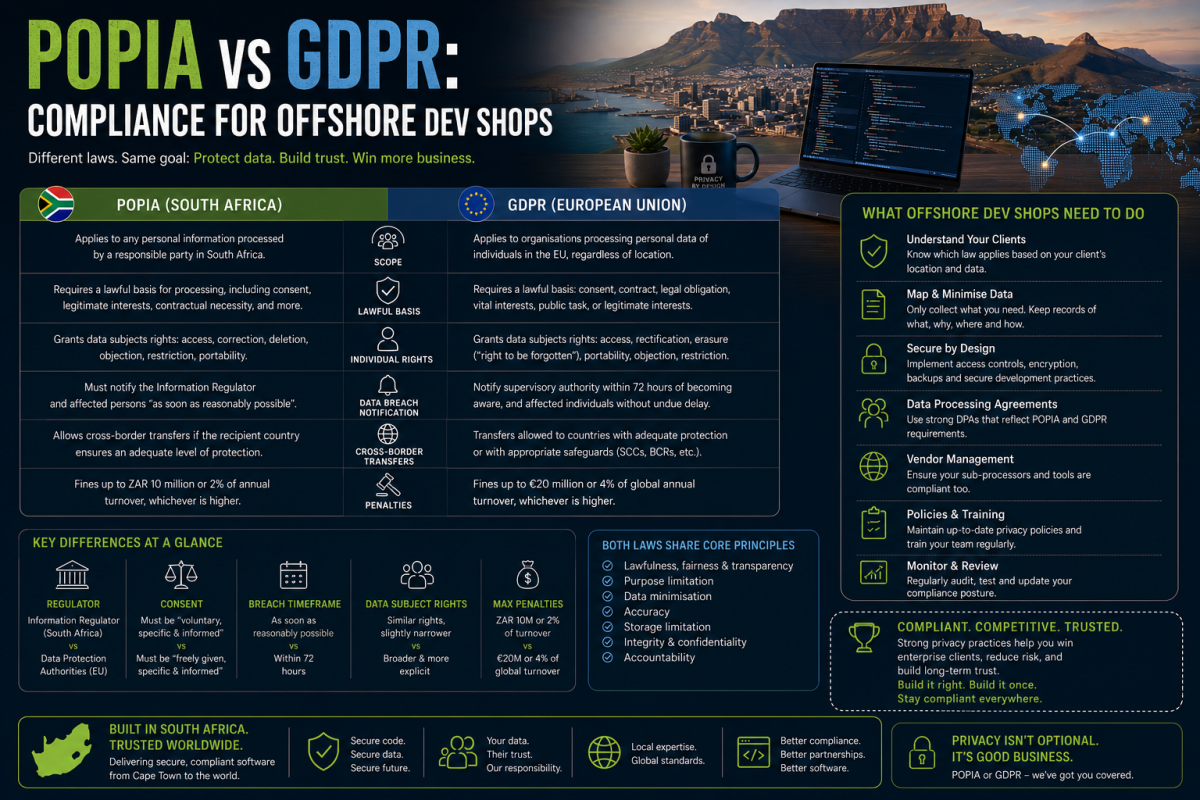
POPIA vs. GDPR: The Cross-Border Data Compliance Manual for Offshore Engineering
For many international companies, selecting a software development partner is no longer just a question of technical capability.
Ten years ago, buyers primarily evaluated:
- Cost
- Technical skills
- Delivery speed
- Industry experience
Today, another factor often sits at the top of the procurement checklist:
Data compliance.
Before a single line of code is written, compliance teams increasingly ask questions such as:
- Where will data be stored?
- Who will have access?
- How is personal information protected?
- What regulations apply?
- What happens if a breach occurs?
- Can this supplier satisfy our compliance requirements?
For companies operating in Europe, the conversation almost always begins with GDPR.
For companies evaluating South African engineering partners, another framework enters the discussion:
POPIA.
Unfortunately, many international buyers are unfamiliar with South Africa's data protection framework.
Some assume South Africa lacks robust privacy legislation.
Others incorrectly believe compliance standards are significantly lower than those found in Europe.
The reality is very different.
South Africa's Protection of Personal Information Act (POPIA) was heavily influenced by global privacy best practices and shares many principles with the European Union's General Data Protection Regulation (GDPR).
For organisations seeking a highly capable nearshore or offshore engineering partner, this creates an important opportunity.
South Africa offers world-class engineering talent, strong legal institutions, mature corporate governance standards, and a modern privacy framework that aligns closely with international expectations.
Understanding this alignment can significantly simplify procurement, vendor approval, and compliance sign-off processes.
Why Data Compliance Has Become a Boardroom Issue
Data protection is no longer an IT problem.
It is no longer simply a legal issue.
It is now a business risk issue.
Data sits at the centre of nearly every modern organisation.
Companies collect:
- Customer information
- Employee records
- Financial data
- Marketing data
- Operational information
- Health information
- Identity documentation
As digital transformation accelerates, the volume of sensitive information continues growing.
At the same time, regulators have become increasingly active.
The result is clear.
Businesses need partners that understand data governance from the beginning.
Not as an afterthought.
The Rise of Global Privacy Standards
Over the past decade, privacy regulation has expanded significantly worldwide.
Governments increasingly recognise that personal data requires protection.
Consumers increasingly expect transparency.
Businesses increasingly demand accountability.
GDPR became one of the most influential frameworks globally.
Many countries subsequently introduced legislation inspired by similar principles.
South Africa was among them.
What Is GDPR?
The General Data Protection Regulation (GDPR) is the European Union's data protection framework.
It establishes rules regarding:
- Data collection
- Data processing
- Data storage
- User rights
- Consent
- Security
- Breach reporting
GDPR applies broadly across European markets and has become one of the most influential privacy regulations in the world.
Many multinational organisations treat GDPR compliance as a baseline requirement.
What Is POPIA?
South Africa's Protection of Personal Information Act (POPIA) serves a similar purpose.
Its objective is straightforward:
Protect personal information and ensure organisations process data responsibly.
POPIA governs how organisations:
- Collect information
- Store information
- Share information
- Secure information
- Process information
Much like GDPR, it establishes responsibilities for organisations handling personal data.
Why International Buyers Often Overlook POPIA
Many procurement teams are highly familiar with:
- GDPR
- CCPA
- HIPAA
- ISO frameworks
Fewer teams have direct exposure to POPIA.
This sometimes creates uncertainty.
However, once compliance teams examine the legislation, they often discover substantial alignment with familiar global standards.
The conversation shifts from:
"Is South Africa compliant?"
to
"How does South Africa compare?"
That distinction is important.
The Philosophical Alignment Between POPIA and GDPR
Both frameworks are built on similar principles.
They recognise that personal information belongs to individuals.
They emphasise:
- Transparency
- Accountability
- Security
- Fair processing
- Data minimisation
- User rights
While implementation details differ, the underlying philosophy remains remarkably similar.
This alignment makes cross-border collaboration significantly easier.
Lawful Processing of Personal Information
Both GDPR and POPIA require organisations to process personal information responsibly.
Data cannot simply be collected without purpose.
Businesses must have legitimate reasons for processing information.
Examples include:
- Contract fulfilment
- Legal obligations
- Customer support
- Operational requirements
- Consent-based activities
This principle creates accountability throughout the data lifecycle.
Data Minimisation Principles
One of the strongest similarities between GDPR and POPIA is data minimisation.
The principle is simple:
Only collect information that is genuinely required.
Many businesses historically adopted a "collect everything" mindset.
Modern privacy frameworks discourage this approach.
Instead, organisations should gather only the information necessary to achieve specific objectives.
This reduces risk.
It also improves security.
User Rights and Transparency
Both regulations place significant emphasis on individual rights.
Individuals generally have the ability to:
- Access information
- Request corrections
- Understand how data is used
- Raise objections
- Request certain actions regarding personal information
These rights encourage transparency.
Transparency builds trust.
Trust strengthens business relationships.
Security Requirements
Security sits at the heart of both frameworks.
Organisations are expected to implement reasonable measures to protect personal information.
Examples include:
- Access controls
- Encryption
- Authentication systems
- Monitoring
- Audit logging
- Secure development practices
Neither framework expects perfection.
Both expect diligence.
The focus is on responsible risk management.
Why This Matters for Software Development
Many people think privacy laws only affect legal teams.
In reality, software developers play a critical role.
Every application influences:
- Data collection
- Data storage
- Data access
- Data sharing
- Data retention
Compliance begins during system design.
Not after launch.
This is why engineering partners must understand privacy requirements from the start.
Privacy by Design
One of the most important modern security concepts is privacy by design.
Rather than adding compliance features later, systems should incorporate privacy considerations from the beginning.
Examples include:
- Role-based permissions
- Encryption
- Audit trails
- Consent management
- Data retention controls
Building these features early reduces risk and future costs.
Cross-Border Data Transfers
One of the most common concerns among international buyers involves data movement.
Questions often include:
- Can data leave Europe?
- Can South African teams access customer information?
- What safeguards are required?
These concerns are legitimate.
Fortunately, both GDPR and POPIA recognise the importance of managing international data transfers responsibly.
The focus is not preventing collaboration.
The focus is ensuring adequate protections exist.
Why South Africa Works Well for Nearshore and Offshore Engineering
South Africa occupies an increasingly attractive position in the global technology ecosystem.
Advantages include:
- Strong English proficiency
- Mature legal systems
- Time-zone compatibility
- High-quality engineering talent
- Competitive operating costs
- Robust privacy legislation
For European organisations, this combination is particularly attractive.
The compliance conversation becomes significantly easier when legal frameworks already share common principles.
Security Expectations Have Changed
Ten years ago, businesses often asked:
"Can you build the software?"
Today, they ask:
"Can you build the software securely?"
The distinction matters.
Modern buyers evaluate:
- Security processes
- Development methodologies
- Data handling procedures
- Vendor governance
- Compliance maturity
Technical capability alone is no longer sufficient.
Trust has become a competitive advantage.
Vendor Risk Assessments
Many international organisations perform extensive vendor reviews.
These assessments often evaluate:
- Security controls
- Data governance
- Privacy frameworks
- Incident response processes
- Access management
South African firms familiar with POPIA often find these assessments easier to navigate because many underlying concepts already align with international expectations.
Building Trust with Compliance Teams
Engineering teams often focus on technical stakeholders.
However, procurement decisions increasingly involve:
- Legal departments
- Risk teams
- Compliance officers
- Security specialists
Winning these stakeholders requires more than technical expertise.
It requires demonstrating operational maturity.
A strong understanding of POPIA and GDPR alignment helps create confidence.
Data Governance as a Competitive Advantage
Many software providers view compliance as a burden.
The best firms view it differently.
Strong governance creates:
- Better systems
- Better processes
- Better security
- Better client relationships
Compliance is not merely about avoiding penalties.
It is about creating trust.
And trust drives long-term business growth.
The Offshore Engineering Perception Gap
Some international buyers still associate offshore development with elevated compliance risk.
This perception often reflects outdated assumptions.
South Africa's modern privacy framework, legal environment, and corporate governance standards challenge these assumptions directly.
For many organisations, the reality is that South African engineering teams can meet the same compliance expectations applied to partners in Europe, North America, or other mature markets.
Why Compliance and Innovation Can Coexist
A common misconception is that compliance slows innovation.
Good engineering proves the opposite.
When privacy and security are built into systems from the beginning:
- Projects move faster
- Risk decreases
- Rework decreases
- Customer trust increases
Compliance becomes an enabler rather than an obstacle.
What International Buyers Should Look For
When evaluating offshore engineering partners, buyers should assess:
Governance
Clear policies and accountability structures.
Security
Strong technical controls and monitoring.
Privacy
Understanding of regulatory obligations.
Development Practices
Secure software engineering processes.
Documentation
Evidence of operational maturity.
These factors often matter more than geographic location alone.
The Future of Global Engineering Partnerships
The software industry continues becoming more distributed.
Companies increasingly build global teams.
Engineering talent moves across borders.
Data moves across borders.
Business processes move across borders.
The ability to operate securely within this environment is becoming essential.
South Africa's combination of engineering capability and privacy regulation positions it well for this future.
Why South Africa Is Emerging as a Trusted Nearshore Partner
Several factors continue strengthening South Africa's position.
These include:
- GDPR-aligned privacy thinking
- Strong English communication
- Growing technology ecosystems
- International business experience
- Mature financial and legal sectors
For European companies seeking nearshore or offshore support, these characteristics significantly reduce adoption barriers.
The Potado Approach
At Potado, we believe security, privacy, and compliance should be integrated into software engineering from the beginning.
Modern applications process valuable information, and businesses need confidence that their technology partners understand the regulatory environments in which they operate.
Our development practices are designed around principles that align closely with both POPIA and GDPR expectations, including responsible data handling, privacy-conscious architecture, secure development methodologies, and transparent governance processes.
The objective is not simply delivering software.
It is delivering software that can withstand scrutiny from legal, compliance, security, and procurement teams alike.
Because successful technology partnerships are built on trust as much as technical capability.
Conclusion
As organisations become increasingly data-driven, privacy and compliance have moved from niche legal concerns to core business priorities. International buyers now expect their technology partners to demonstrate maturity in data protection, security, governance, and risk management.
South Africa's POPIA framework provides a strong foundation for meeting these expectations. While distinct from GDPR, it shares many of the same principles around transparency, accountability, security, lawful processing, and individual rights.
For European and international organisations evaluating offshore engineering partners, this alignment offers significant reassurance. It reduces compliance friction, simplifies procurement reviews, and creates confidence that personal information will be handled responsibly.
The result is a compelling proposition.
South Africa combines world-class engineering talent, competitive operating costs, strong English-language communication, mature corporate governance standards, and a modern privacy framework that aligns closely with international expectations.
For organisations seeking a trusted nearshore development partner, that combination is increasingly difficult to ignore.
And for compliance teams tasked with protecting both customers and businesses, it is a combination that is becoming easier and easier to approve.