
Managed Technical Pods vs Remote Freelancers
15/06/2026
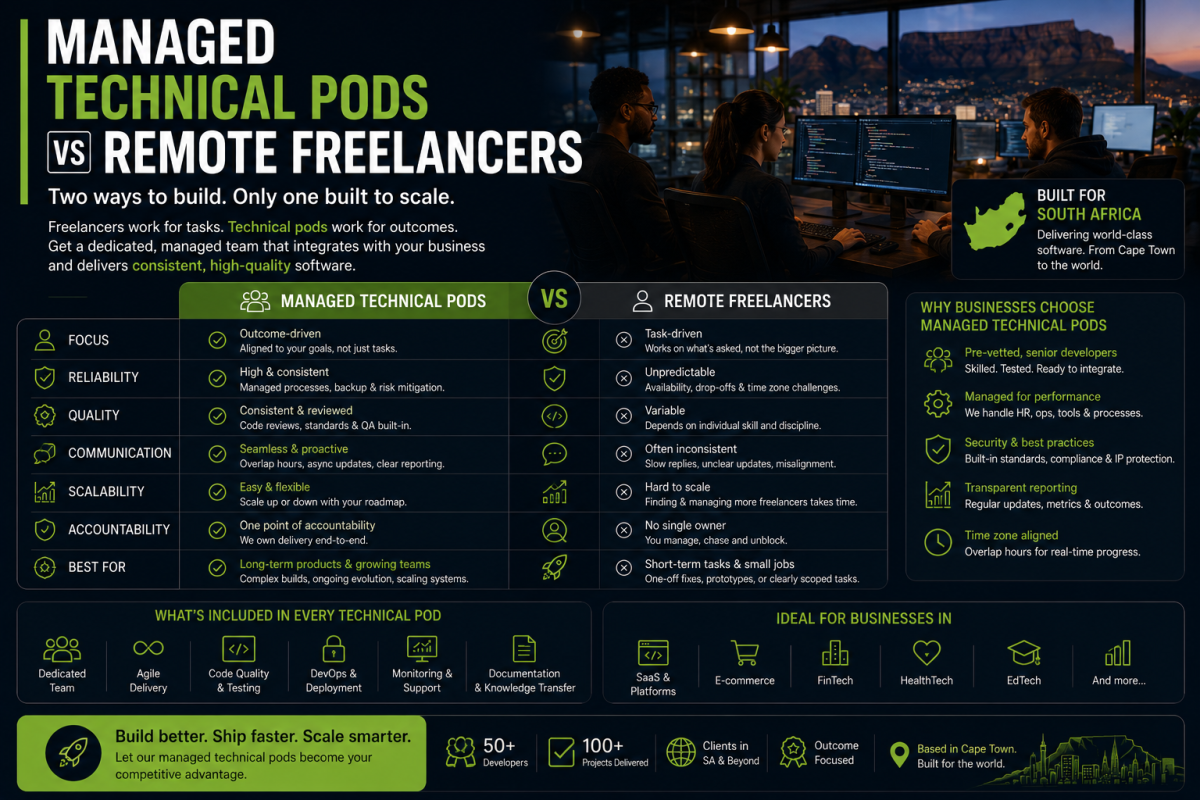
Managed Technical Pods vs. Freelance Chaos: Scaling Your Agency Delivery Smoothly
For many agencies, the growth journey follows a familiar pattern.
The business begins with a small team.
Clients arrive.
Projects increase.
Revenue grows.
Everything feels manageable.
Then something changes.
The agency starts winning larger accounts.
Project complexity increases.
Client expectations rise.
Delivery requirements multiply.
Suddenly, the original team cannot handle the workload alone.
At this point, most agency owners face an important decision:
How do we increase delivery capacity without destroying operational efficiency?
Traditionally, two solutions dominate the conversation.
The first is hiring local employees.
The second is hiring freelancers.
Increasingly, agencies are discovering that both options come with significant limitations.
Local hiring is expensive and often slow.
Freelancers can provide flexibility, but they frequently introduce management overhead, communication complexity, and delivery inconsistency.
As agencies continue scaling, a new model is emerging.
A model designed specifically for predictable growth.
A model built around managed technical pods.
And for many European agencies, it is becoming one of the most effective ways to expand delivery capacity without creating operational chaos.
The Freelancer Trap
Most agency owners have experienced it.
A project requires additional capacity.
Hiring a full-time employee feels excessive.
A freelancer appears to be the perfect solution.
The process seems simple.
Find a contractor.
Assign work.
Receive deliverables.
Move forward.
Initially, it often works.
One freelancer becomes two.
Two become five.
Five become ten.
Suddenly the agency owner discovers an unexpected reality.
They are no longer managing projects.
They are managing freelancers.
Why Freelancers Create Hidden Complexity
Freelancers offer flexibility.
That flexibility is valuable.
However, every freelancer introduces additional coordination requirements.
Questions emerge constantly:
- Who is responsible for what?
- Who reviews quality?
- Who ensures deadlines are met?
- Who manages communication?
- Who handles handovers?
- Who resolves technical conflicts?
As the number of freelancers increases, complexity increases.
The agency often becomes dependent on individual contributors rather than structured systems.
This creates risk.
The Myth of "Easy Scaling"
Many agencies assume scaling delivery simply means adding more people.
In reality, scaling people and scaling systems are completely different challenges.
Adding freelancers increases capacity.
But it also increases management requirements.
Without proper structure, every new freelancer creates:
- More communication
- More oversight
- More coordination
- More dependency
Eventually, management overhead begins consuming the very capacity the freelancers were meant to create.
When the Founder Becomes the Project Manager
One of the most common growth bottlenecks occurs when agency founders become operational bottlenecks.
Every decision flows through them.
Every freelancer requires direction.
Every issue requires escalation.
Every deadline requires monitoring.
Instead of focusing on:
- Sales
- Strategy
- Growth
- Client relationships
The founder spends their time chasing updates.
This is not scalable.
And it happens more often than many agencies realise.
The EOR Alternative
Some businesses attempt to solve the problem using Employer of Record (EOR) services.
The EOR model simplifies international hiring by handling:
- Payroll
- Compliance
- Employment administration
- Local regulations
This solves an important problem.
But it does not solve the operational problem.
The employees still require management.
The agency still needs:
- Team leaders
- Delivery systems
- Operational oversight
- Project coordination
The EOR handles employment administration.
The agency still handles everything else.
Why Management Is the Real Cost
Most businesses focus heavily on salary costs.
They often underestimate management costs.
Consider two scenarios.
Scenario One
Five freelancers.
Five reporting structures.
Five communication channels.
Five workflow preferences.
Five different schedules.
Scenario Two
One managed pod.
One reporting structure.
One communication framework.
One delivery process.
The difference becomes obvious.
The challenge is rarely talent.
The challenge is coordination.
The Rise of Managed Technical Pods
Managed technical pods represent a different approach.
Instead of hiring isolated individuals, businesses gain access to a coordinated team structure.
The pod functions as a cohesive unit.
Rather than managing five separate contributors, the client interacts with a unified delivery team.
This dramatically reduces operational complexity.
What Is a Managed Technical Pod?
A managed technical pod is a self-organising delivery team designed around specific business objectives.
The composition varies depending on requirements.
A pod may include:
- Frontend developers
- Backend developers
- Quality assurance specialists
- Designers
- Digital marketers
- SEO specialists
- Automation experts
Most importantly, the pod operates through structured internal leadership.
This creates accountability.
And accountability creates consistency.
Why Teams Outperform Individuals
Businesses often focus on individual talent.
However, project success usually depends on team effectiveness.
A highly skilled developer working in isolation may still struggle if:
- Communication is poor
- Priorities are unclear
- Requirements are inconsistent
Strong systems often outperform individual brilliance.
Managed pods are designed around this principle.
The objective is not simply hiring talent.
The objective is creating delivery capacity.
The Communication Problem Nobody Talks About
One of the biggest challenges in distributed teams is communication fragmentation.
Each freelancer introduces:
- Different communication habits
- Different workflows
- Different expectations
The result is operational noise.
Project managers spend significant amounts of time simply keeping everyone aligned.
A managed pod reduces this complexity.
Internal communication happens within the pod.
The client receives consolidated updates.
This improves efficiency dramatically.
Why Self-Managing Teams Matter
The highest-performing organisations increasingly rely on self-managing teams.
These teams operate with:
- Clear objectives
- Defined processes
- Internal accountability
- Structured leadership
Rather than requiring constant supervision, they solve problems independently.
This creates leverage.
And leverage is essential for scaling.
The Operations Lead Advantage
One of the most valuable components of a managed pod is the operations lead.
The operations lead acts as:
- Coordinator
- Facilitator
- Escalation point
- Delivery manager
- Accountability owner
Instead of clients managing individual contributors, they interact with a single operational contact.
This dramatically reduces management overhead.
Why Agency Owners Need Leverage
Most agencies do not fail because they lack talent.
They struggle because leadership capacity becomes exhausted.
The founders become trapped inside delivery operations.
Growth slows.
Innovation slows.
Business development slows.
Managed pods help restore leverage.
The founder regains time.
The team gains structure.
The business gains scalability.
The Cost of Context Switching
Managing multiple freelancers often creates constant interruptions.
Questions arrive throughout the day.
Updates require review.
Tasks require clarification.
Each interruption seems minor.
Collectively, they consume enormous amounts of time.
Research consistently shows that context switching reduces productivity.
Managed pods reduce these interruptions significantly.
Information becomes consolidated.
Communication becomes structured.
Workflows become smoother.
Why Delivery Consistency Matters
Clients value consistency.
They want predictable outcomes.
Predictable communication.
Predictable timelines.
Predictable quality.
Freelancer-heavy delivery models can sometimes struggle to provide this consistency.
Managed teams create stronger operational standards.
Processes become repeatable.
Results become more reliable.
Trust increases.
Scaling Without Hiring Headaches
Recruitment is expensive.
It is also slow.
Many agencies experience months-long hiring cycles.
Even after finding candidates, there are onboarding requirements.
Training requirements.
Process integration requirements.
Managed pods accelerate this process.
Businesses gain immediate access to established teams rather than assembling teams from scratch.
The Cape Town Advantage
Cape Town has emerged as one of the most attractive destinations for international agency support.
The city offers:
- Strong technical talent
- Native English communication
- Time zone alignment
- Modern infrastructure
- Western business culture
These factors make collaboration significantly easier than many traditional offshore arrangements.
The result is stronger integration.
And stronger integration produces better outcomes.
Why Time Zone Alignment Matters
Many agencies underestimate the value of real-time collaboration.
Working across large time differences introduces delays.
Questions wait for answers.
Approvals wait for reviews.
Projects wait for decisions.
Cape Town aligns closely with European business hours.
This creates substantial operational advantages.
Teams collaborate in real time.
Problems get solved faster.
Projects move forward more efficiently.
Beyond Developers
Many agencies focus exclusively on engineering capacity.
In reality, delivery often requires multidisciplinary teams.
Projects increasingly involve:
- Development
- SEO
- Paid advertising
- Automation
- Analytics
- Content
- Design
Managed pods can incorporate multiple disciplines within a single operational structure.
This creates stronger execution.
The Financial Case
Freelancers often appear cheaper initially.
However, hidden costs accumulate.
These include:
- Management overhead
- Recruitment time
- Quality control
- Delivery delays
- Coordination complexity
When these factors are considered, managed teams often provide significantly better value.
The true cost of delivery extends far beyond hourly rates.
Creating Predictable Capacity
Agencies need confidence.
They need to know that when new projects arrive, delivery capacity exists.
Managed pods create predictable capacity.
The team remains intact.
Knowledge remains inside the pod.
Processes remain stable.
Growth becomes easier to manage.
The Future of Agency Operations
Agency delivery models are evolving.
The traditional approaches of:
- Hiring individual freelancers
- Building fragmented contractor networks
- Managing isolated contributors
are becoming increasingly difficult to scale.
Businesses require systems that support growth.
Managed pods represent one of the most effective responses to this challenge.
They combine flexibility with structure.
Scalability with accountability.
Cost efficiency with operational consistency.
Why Clients Care Too
The benefits extend beyond agency owners.
End clients experience:
- Faster delivery
- Better communication
- Higher consistency
- Improved accountability
Projects become smoother.
Relationships become stronger.
Client retention improves.
This creates compounding value over time.
The Potado Approach
At Potado, we believe delivery capacity should be built around teams rather than isolated individuals.
Our managed technical pod framework combines experienced Cape Town-based developers, marketers, designers, and specialists into coordinated delivery units supported by internal operational leadership.
Rather than requiring clients to manage multiple freelancers, coordinate disparate contractors, or build complex international hiring structures, we provide self-managing teams designed to integrate seamlessly into existing agency operations.
The objective is not simply providing talent.
It is providing operational leverage.
Because the fastest-growing agencies are rarely those with the most freelancers.
They are the ones with the strongest delivery systems.
Conclusion
As agencies scale, the challenges they face become less about finding talent and more about managing complexity.
Freelancers provide flexibility, but they often introduce coordination challenges, communication overhead, inconsistent workflows, and increased management demands. Employer of Record models simplify hiring administration but still leave agencies responsible for operational leadership and team coordination.
Managed technical pods offer a different approach.
By providing self-managing teams supported by dedicated operational leadership, they reduce management overhead, improve delivery consistency, accelerate project execution, and create scalable capacity without requiring agency owners to become full-time project coordinators.
For European businesses seeking to expand delivery capabilities, Cape Town offers an especially compelling foundation. The combination of strong technical talent, native English communication, cultural compatibility, and timezone alignment creates an environment where managed pods can operate as true extensions of internal teams.
The result is not simply a more efficient workforce.
It is a more scalable business.
And in an increasingly competitive market, scalability may be the most valuable asset an agency can build.