
Local SEO Strategy for Cape Town Tech Hubs
11/06/2026
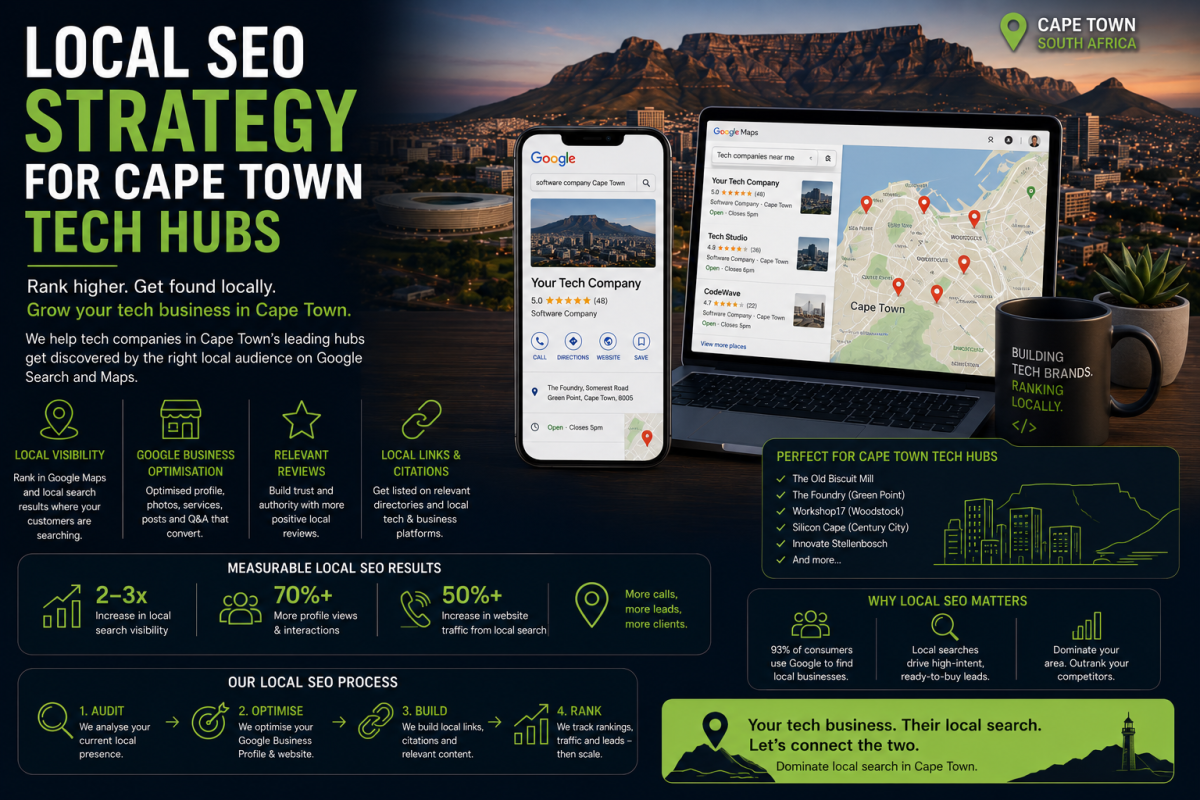
Local SEO Domination: Capturing the Cape Town Tech and Commercial Corridor
For many businesses, SEO feels like a global competition.
Companies spend months chasing broad keywords.
They try to rank nationally.
Sometimes they even attempt to rank internationally.
The problem is that most businesses do not actually need global visibility.
They need local visibility.
A law firm in Century City does not need visitors from New York.
A software consultancy in Foreshore does not need traffic from Sydney.
A commercial property broker in Tyger Valley does not need thousands of visitors from Europe.
They need qualified local buyers.
They need decision-makers.
They need businesses searching for services nearby.
This is where Local SEO becomes incredibly powerful.
When executed correctly, Local SEO allows businesses to dominate specific geographic markets and capture highly qualified traffic with significantly less competition than broad national campaigns.
For businesses operating in Cape Town's growing commercial corridor, this opportunity is enormous.
Areas such as:
- Foreshore
- Green Point
- Century City
- Tyger Valley
- Claremont
- Woodstock
- Bellville
- Waterfront precincts
represent some of the highest-value business zones in South Africa.
Companies competing for visibility in these locations often underestimate how mathematical local search actually is.
The businesses appearing consistently in local search results are rarely there by accident.
They have built systems.
They have built authority.
And they have built geographic relevance.
Why Local SEO Is Different from Traditional SEO
Many businesses assume local SEO is simply normal SEO with a city name attached.
It is not.
Traditional SEO focuses on topics.
Local SEO focuses on geography.
Google must answer two questions simultaneously:
- Is this business relevant?
- Is this business nearby?
Both factors matter.
You may have the best content in South Africa.
But if Google believes another business is more geographically relevant, that business may outrank you locally.
This is why location signals are so important.
Understanding the Google Map Pack
One of the most valuable positions in local search is the Google Map Pack.
This is the group of businesses that appears alongside map results when users search for local services.
For example:
- Software company Cape Town
- Accountant Century City
- Commercial property broker Green Point
- IT support Foreshore
These listings often receive a significant share of clicks.
In many cases, users never scroll to the traditional organic results.
They select directly from the map listings.
This means Map Pack visibility is often more valuable than traditional rankings.
Why Geography Creates Opportunity
Most businesses think competition occurs at the city level.
In reality, competition often occurs at the district level.
For example:
Ranking for:
Software development Cape Town
is highly competitive.
Ranking for:
Software development Foreshore
or
Software development Century City
may be significantly easier.
Yet the traffic is often more qualified.
The searcher knows exactly where they want to work.
That creates a major opportunity for local businesses.
The Cape Town Commercial Corridor
Cape Town's economic activity is increasingly concentrated across several high-value commercial nodes.
Each area develops its own business ecosystem.
Foreshore
Corporate headquarters.
Professional services.
Technology firms.
Financial services.
Green Point
Creative agencies.
Boutique consultancies.
Property businesses.
Professional practices.
Century City
Technology companies.
Business parks.
Corporate offices.
Shared workspaces.
Tyger Valley
Commercial property.
Professional services.
Regional corporate operations.
Financial advisory businesses.
Each zone generates its own search behaviour.
Understanding this behaviour creates competitive advantages.
Local SEO Is a Relevance Equation
At its core, local SEO operates like a scoring system.
Google evaluates signals including:
- Location relevance
- Website authority
- Reviews
- Business consistency
- Geographic mentions
- User engagement
- Citations
- Local links
The stronger your overall profile becomes, the more likely you are to dominate local results.
This is not random.
It is cumulative.
Every optimisation strengthens the system.
The Power of Local Semantic Link Density
One of the most overlooked concepts in local SEO is semantic link density.
This sounds technical.
The principle is simple.
Google wants to understand how strongly your business is associated with a specific area.
Many websites mention Cape Town once or twice.
That is not enough.
Strong local websites naturally create connections between:
- Services
- Industries
- Locations
- Landmarks
- Business districts
For example, a technology company serving Century City should create meaningful content connecting:
- Software development
- Century City
- Technology businesses
- Digital transformation
- Corporate innovation
The more contextual relationships Google sees, the stronger local relevance becomes.
Building Geographic Authority Pages
Many businesses rely on a single contact page.
This is a mistake.
Local SEO leaders often create dedicated geographic content.
Examples include:
- Software Development in Century City
- IT Consulting in Green Point
- Digital Transformation for Foreshore Businesses
- Technology Solutions for Tyger Valley Companies
These pages provide contextual signals that help search engines understand service coverage.
The goal is not keyword stuffing.
The goal is demonstrating genuine local relevance.
Why Location-Specific Content Wins
Businesses often publish generic content.
Unfortunately, generic content rarely creates local authority.
Compare these two articles:
Generic
"The Benefits of Cloud Computing"
Local
"How Century City Businesses Are Modernising Operations with Cloud Infrastructure"
The second article creates stronger geographic relevance.
Google learns:
- The topic
- The location
- The audience
All at the same time.
This creates powerful ranking signals.
Google Business Profile Is the Foundation
Many companies obsess over websites while neglecting their Google Business Profile.
This is a major mistake.
For local SEO, the Google Business Profile is one of the most important assets available.
Optimisation should include:
- Accurate business information
- Service descriptions
- Categories
- Photos
- Updates
- FAQs
- Reviews
An incomplete profile limits visibility.
A complete profile strengthens it.
Reviews Are More Powerful Than Most Businesses Realise
Reviews do more than build trust.
They create local search signals.
Every review contributes information.
Google analyses:
- Frequency
- Quality
- Recency
- Relevance
Reviews mentioning services and locations can strengthen geographic associations.
For example:
"Excellent software development partner in Century City."
or
"Great IT consulting team serving our Foreshore office."
These references help reinforce local relevance.
Structural Review Generation Systems
The best-performing businesses do not collect reviews randomly.
They build systems.
Every successful project triggers:
- Follow-up communication
- Review requests
- Feedback collection
- Reputation management
This creates consistent review growth.
Consistency matters.
Ten reviews arriving over ten months often outperform ten reviews arriving in one week.
Google prefers natural patterns.
The Importance of Citation Consistency
A citation is any online mention of your business.
Examples include:
- Directories
- Industry websites
- Local chambers
- Professional associations
- Business listings
Google compares these references.
Consistency is critical.
Your:
- Business name
- Address
- Phone number
- Website
should match everywhere.
Even small inconsistencies can weaken local trust signals.
Building Local Link Authority
Backlinks remain important.
But local SEO rewards local relevance.
A link from a Cape Town business association may be more valuable than a random international directory.
Local authority sources include:
- Business chambers
- Industry organisations
- Regional publications
- Community initiatives
- Local event sponsors
These links reinforce geographic relevance.
The Role of Geographic Location Tags
Many businesses underutilise location data.
Modern websites can incorporate location signals through:
- Structured data
- Schema markup
- Location-specific content
- Geographic references
- Embedded maps
These elements help search engines understand where a business operates.
The stronger the geographic signals, the stronger local ranking potential becomes.
Schema Markup and Local Search
Schema provides machine-readable information.
For local businesses, schema can communicate:
- Physical location
- Service areas
- Business categories
- Contact information
- Reviews
- Operating hours
This improves search engine understanding.
And improved understanding often leads to improved visibility.
Building Local Topic Clusters
One powerful strategy involves creating local content clusters.
Instead of one page targeting:
Cape Town software development
build an ecosystem.
Examples:
- Software Development Century City
- Enterprise Software Foreshore
- CRM Solutions Green Point
- Workflow Automation Tyger Valley
- AI Consulting Cape Town CBD
Together, these pages create a network of local authority.
Google begins recognising patterns.
Authority compounds.
Why Most Competitors Never Do This Properly
The reason local SEO remains so effective is simple.
Most businesses never execute it systematically.
They:
- Create a Google profile
- Add a few keywords
- Publish occasional content
Then they stop.
Meanwhile, local search leaders continue building signals month after month.
Over time, the gap widens.
The strongest businesses become increasingly difficult to displace.
The Mathematics of Local Dominance
Local SEO is often less about individual tactics and more about cumulative strength.
Imagine two competitors.
Business A has:
- 20 reviews
- 5 local citations
- 3 location pages
- 10 local backlinks
Business B has:
- 150 reviews
- 50 citations
- 25 location pages
- 40 local backlinks
- Structured schema
- Active profile management
Which business is Google more likely to trust?
The answer becomes obvious.
Local domination is usually the result of systematic signal accumulation.
Mobile Search Changes Everything
Many local searches happen on mobile devices.
Users often search while:
- Driving
- Commuting
- Attending meetings
- Visiting commercial districts
This means local SEO and mobile optimisation are deeply connected.
Businesses need:
- Fast websites
- Clear contact information
- Click-to-call functionality
- Mobile-friendly layouts
Poor mobile experiences reduce conversion rates even if rankings remain strong.
Capturing Commercial Intent
One of the biggest advantages of local SEO is intent.
Someone searching:
Accountant Tyger Valley
is not casually browsing.
They are actively seeking a solution.
The same applies to:
- Lawyer Century City
- Software company Foreshore
- Consultant Green Point
These searches often occur close to purchase decisions.
That makes local traffic exceptionally valuable.
The Future of Local Search
Local search is becoming increasingly sophisticated.
Google now evaluates:
- User behaviour
- Geographic relevance
- Entity authority
- Review quality
- Brand trust
- Local prominence
Businesses that build strong local ecosystems will continue benefiting from these trends.
Those relying on outdated tactics may struggle.
Why Cape Town Remains a Unique Opportunity
Cape Town continues attracting:
- Technology firms
- International businesses
- Startups
- Professional service providers
- Commercial investors
Competition is increasing.
But many businesses still underinvest in local SEO.
This creates opportunity.
Especially across high-value commercial zones where purchase intent is strongest.
A Practical Local SEO Roadmap
Businesses seeking local dominance should focus on:
Phase One
- Optimise Google Business Profile
- Standardise citations
- Implement schema markup
Phase Two
- Build location-specific service pages
- Create local authority content
- Improve mobile performance
Phase Three
- Build review generation systems
- Earn local backlinks
- Expand geographic coverage
Phase Four
- Measure rankings
- Refine content
- Strengthen authority signals
Over time, these efforts compound.
Conclusion
Local SEO is one of the most powerful and underutilised growth strategies available to businesses operating within Cape Town's commercial corridor.
While many companies chase broad national rankings, the most valuable opportunities often exist much closer to home. Areas such as Foreshore, Green Point, Century City, and Tyger Valley contain concentrated clusters of high-intent buyers actively searching for services.
Dominating these markets is not about luck. It is about building a system of geographic relevance through local semantic link density, location-focused content, review generation, citation consistency, schema markup, and authoritative local signals.
Businesses that approach local SEO strategically create a compounding advantage. Each review, citation, backlink, location page, and optimisation strengthens their visibility, making them increasingly difficult for competitors to overtake.
In an environment where many businesses still treat local SEO as an afterthought, those who invest early and systematically have an opportunity to own their local market for years to come.
And in highly valuable commercial zones across Cape Town, that visibility can translate directly into enquiries, leads, clients, and long-term business growth.