
Intent-Driven Coding: The Shift in Software Dev
07/06/2026
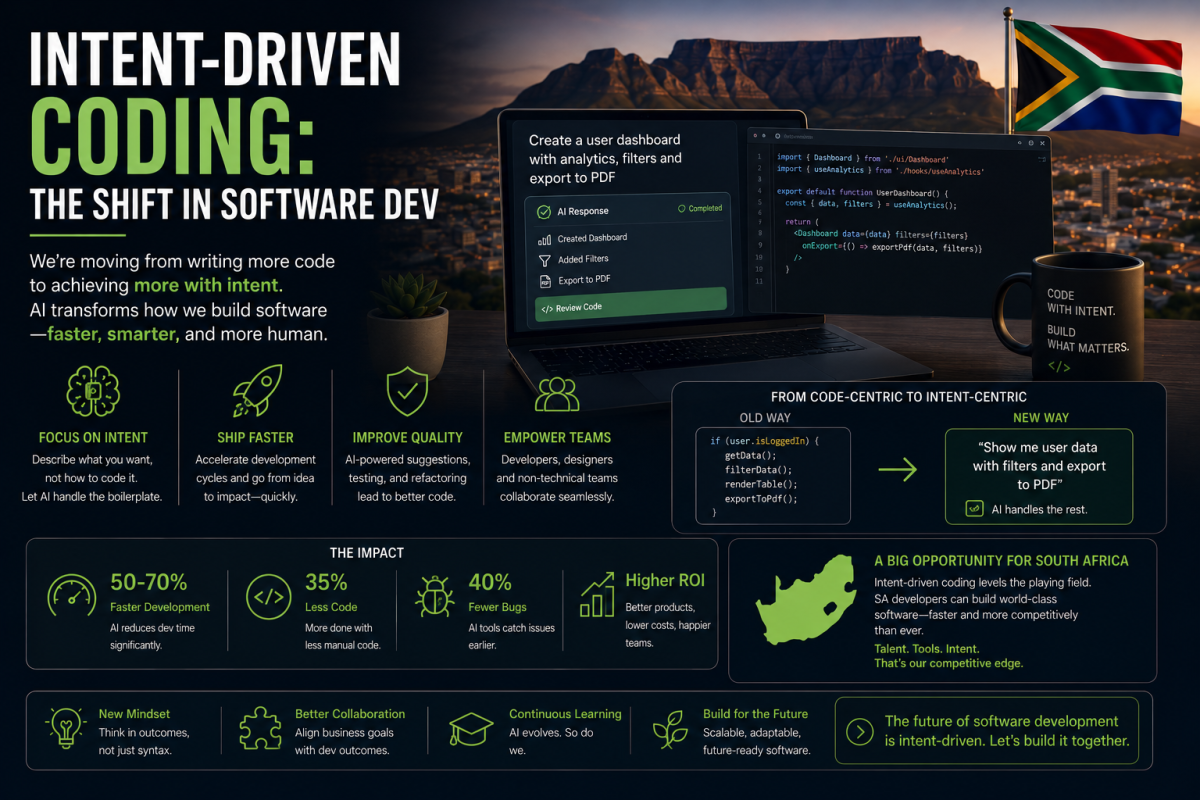
Intent-Driven Coding: Why the Way We Build Software Completely Changed
For decades, software development followed a relatively simple formula.
A business had a problem.
Developers gathered requirements.
Engineers wrote thousands of lines of code.
The software was tested.
Bugs were fixed.
The product was released.
Then the cycle started again.
This model built the modern digital world. It powered banking systems, logistics platforms, mobile applications, e-commerce stores, customer portals, and virtually every piece of software businesses use today.
But something fundamental has changed.
For the first time since the birth of modern software engineering, the primary skill is no longer simply writing code.
The most important skill is increasingly becoming the ability to clearly communicate intent.
In other words, software development is shifting from manually constructing every component line by line to orchestrating intelligent systems that can build, test, improve, and optimise software based on human direction.
This shift is often misunderstood as "AI writing code."
In reality, something much bigger is happening.
We are entering the era of Intent-Driven Coding.
And it is fundamentally changing how software gets built.
The Traditional Software Development Model
To understand why this change matters, it helps to understand how software has traditionally been built.
Imagine a company wants a new client portal.
The traditional process might look like this:
- Gather requirements
- Design wireframes
- Build database structures
- Create backend APIs
- Develop frontend interfaces
- Write authentication systems
- Build user management
- Add reporting features
- Test functionality
- Fix bugs
- Deploy the system
Every step requires developers to manually convert ideas into code.
The developer effectively acts as a translator between business goals and technical implementation.
The challenge is that translation takes time.
Lots of time.
Even highly skilled engineering teams spend significant portions of projects writing repetitive code that has already been written thousands of times before.
Login systems.
CRUD interfaces.
Data validation.
Database models.
Administrative dashboards.
API endpoints.
Notification systems.
The work is necessary, but much of it is repetitive.
Historically, there was no alternative.
Today, there is.
Software Development's New Layer
Artificial intelligence has introduced a new layer between human intent and software creation.
Instead of writing every implementation detail manually, developers can increasingly describe what they want and allow AI systems to generate large portions of the technical work.
This doesn't mean developers disappear.
Far from it.
What changes is where their value is created.
Previously, developers spent enormous amounts of time building components.
Now they spend increasing amounts of time designing systems, defining outcomes, validating results, and orchestrating workflows.
The focus shifts upward.
Less time typing.
More time thinking.
Less time implementing.
More time architecting.
The Rise of Intent-Driven Development
Intent-driven development starts with a simple idea:
Instead of telling a computer exactly how to do something, you tell it what outcome you want.
Consider a traditional instruction:
Create a database table called customers with these fields. Build API endpoints. Add validation. Create an admin interface.
A modern intent-driven instruction might be:
Build a customer management system with role-based access, reporting, CSV exports, and audit logging.
The AI system can generate much of the implementation.
The developer then reviews, refines, tests, and improves the result.
The developer becomes the conductor.
The AI becomes part of the orchestra.
The software still requires expertise.
The expertise simply moves higher up the value chain.
Why This Changes Everything
Many technological advances improve software development incrementally.
Intent-driven coding changes it structurally.
It affects:
- Development speed
- Project cost
- Team size
- Product quality
- Time to market
- Innovation capacity
The biggest change is not that code can be generated faster.
The biggest change is that ideas can be tested faster.
Historically, businesses often delayed innovation because implementation costs were too high.
A new feature might take weeks.
A new product might take months.
Today, many ideas can be validated in days.
That dramatically changes business decision-making.
The End of Boilerplate Work
One of the least glamorous aspects of software engineering is boilerplate code.
Every application requires similar foundations:
- Authentication
- User management
- Permissions
- APIs
- Database operations
- Form validation
- Notifications
- Reporting
Traditionally, developers built these repeatedly.
AI now handles much of this repetitive work exceptionally well.
This creates a major productivity shift.
Developers spend less time rebuilding standard components.
They spend more time solving unique business problems.
That is where the greatest value has always existed.
Why Software Engineering Is Not Disappearing
A common misconception is that AI replaces software engineers.
In practice, the opposite is often happening.
The importance of experienced engineers is increasing.
The difference is that their responsibilities are evolving.
Businesses still need professionals who understand:
- System architecture
- Security
- Scalability
- Data modelling
- Performance optimisation
- Compliance
- Integration strategy
AI can generate code.
It cannot reliably assume responsibility for business-critical decisions.
Human oversight remains essential.
The role changes from builder to architect.
From coder to orchestrator.
From implementer to strategist.
The New Competitive Advantage
As coding becomes easier, something else becomes more valuable.
Clarity.
The companies that can clearly define business requirements gain an enormous advantage.
Why?
Because AI systems perform best when given precise intent.
Vague requirements produce vague results.
Clear requirements produce exceptional results.
The ability to communicate exactly what a business needs is becoming one of the most important skills in software development.
This applies to:
- Product managers
- Business analysts
- Founders
- Engineers
- Designers
- Operations teams
Everyone benefits from clearer thinking.
Everyone benefits from clearer communication.
Speed Is Becoming a Strategic Weapon
In competitive markets, speed matters.
The ability to launch products quickly creates advantages that extend far beyond technology.
Faster development means:
- Faster validation
- Faster feedback
- Faster iteration
- Faster market entry
- Faster revenue generation
Companies that can move quickly often outperform competitors with larger budgets but slower execution.
Intent-driven coding dramatically accelerates this process.
The time between idea and implementation continues shrinking.
That changes how businesses compete.
What This Means for South African Businesses
South African companies often face unique constraints.
Budgets may be tighter than those of international competitors.
Hiring specialised technical talent can be challenging.
Projects must deliver measurable returns.
These realities make efficiency particularly important.
Intent-driven development helps level the playing field.
A relatively small engineering team can now accomplish work that previously required significantly larger teams.
This allows businesses to:
- Build faster
- Experiment more
- Reduce costs
- Launch sooner
- Scale more efficiently
For many organisations, this represents a major opportunity.
The Cape Town Technology Advantage
Cape Town has established itself as one of Africa's leading technology hubs.
The city combines:
- Strong technical talent
- Entrepreneurial culture
- International connectivity
- Growing startup ecosystems
- World-class digital agencies
As AI-powered development tools mature, Cape Town teams are increasingly positioned to compete globally.
The traditional advantage of larger international development teams is becoming less important.
What matters more is how effectively teams can leverage intelligent systems.
The best teams are not necessarily the largest.
They are often the most adaptive.
How Potado Approaches Intent-Driven Development
At Potado, we recognised early that AI was not simply another development tool.
It represented a shift in how software gets built.
Rather than viewing AI as a replacement for developers, we viewed it as a force multiplier.
Our engineering teams use AI systems to accelerate repetitive development work while maintaining strict human oversight over architecture, quality assurance, security, and business logic.
This creates a fundamentally different development workflow.
Instead of spending valuable engineering hours on routine implementation tasks, our teams focus on:
- Product strategy
- System architecture
- User experience
- Workflow optimisation
- Integration design
- Quality control
The result is significantly faster execution without sacrificing quality.
Amplifying Development Velocity
One of the most noticeable outcomes of intent-driven development is increased sprint velocity.
Traditional development cycles often contain substantial implementation overhead.
AI dramatically reduces much of this burden.
Tasks that previously consumed days may now take hours.
Tasks that previously required multiple iterations may be completed in a single development cycle.
At Potado, this allows our Cape Town teams to move substantially faster than traditional software delivery models.
In many projects, development velocity can increase by multiple factors compared to historical approaches.
This acceleration creates tangible benefits for clients.
Projects launch sooner.
Features reach users faster.
Feedback loops shorten.
Return on investment arrives earlier.
Faster Delivery Without Larger Teams
Historically, increasing output often required increasing headcount.
More projects meant more developers.
More developers meant higher costs.
Intent-driven development changes that equation.
By increasing the productivity of existing teams, businesses can achieve greater output without proportionally increasing staffing requirements.
This is particularly important in an environment where skilled technical talent remains expensive and highly competitive.
Efficiency becomes a growth strategy.
Not merely a cost-saving exercise.
Better Use of Human Talent
Perhaps the greatest benefit is not speed.
It is focus.
Highly skilled developers should spend their time solving difficult problems.
They should not spend their days writing repetitive infrastructure code.
Intent-driven development allows engineering teams to focus on:
- Innovation
- Architecture
- User experience
- Business logic
- Product differentiation
These areas create real competitive advantage.
These areas create real business value.
AI handles more of the routine work.
Humans focus on what humans do best.
Why Time-to-Market Matters More Than Ever
Markets move quickly.
Customer expectations evolve rapidly.
Opportunities appear and disappear faster than ever before.
In this environment, time-to-market becomes critically important.
The company that launches first often gains:
- Early customer feedback
- Brand recognition
- Market share
- Revenue momentum
- Competitive positioning
Intent-driven development enables organisations to reach the market faster.
This is not merely a technical benefit.
It is a strategic business advantage.
The Future Is Human-Led, AI-Amplified
The future of software development is unlikely to be fully automated.
Instead, it will be increasingly collaborative.
Humans define goals.
AI accelerates execution.
Humans review outcomes.
AI handles repetition.
Humans provide judgment.
AI provides scale.
The combination is far more powerful than either working alone.
This is the model that forward-thinking organisations are already embracing.
Beyond Coding
The implications extend beyond software engineering.
Intent-driven systems are beginning to influence:
- Product management
- Design
- Marketing
- Customer support
- Operations
- Data analysis
The same principle applies everywhere.
Clear intent becomes leverage.
The ability to define desired outcomes becomes increasingly valuable.
Organisations that master this capability will move faster than those that do not.
Conclusion
Software development is undergoing one of the most significant transformations in its history.
For decades, success depended largely on the ability to manually translate business requirements into code. Today, the focus is shifting toward something much more powerful: defining intent and orchestrating intelligent systems that can execute it.
This does not eliminate the need for skilled engineers. It elevates their role. The most successful development teams are becoming architects, strategists, and orchestrators rather than simply code producers.
For businesses, the implications are profound. Faster delivery, reduced development overhead, improved experimentation, and shorter paths to market are becoming achievable realities.
At Potado, we believe this shift represents the future of software engineering. By combining experienced Cape Town development teams with modern AI-assisted workflows, we are able to dramatically accelerate delivery timelines while maintaining the quality, oversight, and strategic thinking that complex software projects require.
The future of software is not about replacing developers.
It is about amplifying them.
And the companies that embrace this shift earliest will be the ones that move fastest, innovate most effectively, and create the greatest value in the years ahead.