
Generative Engine Optimization for SA Businesses
08/06/2026
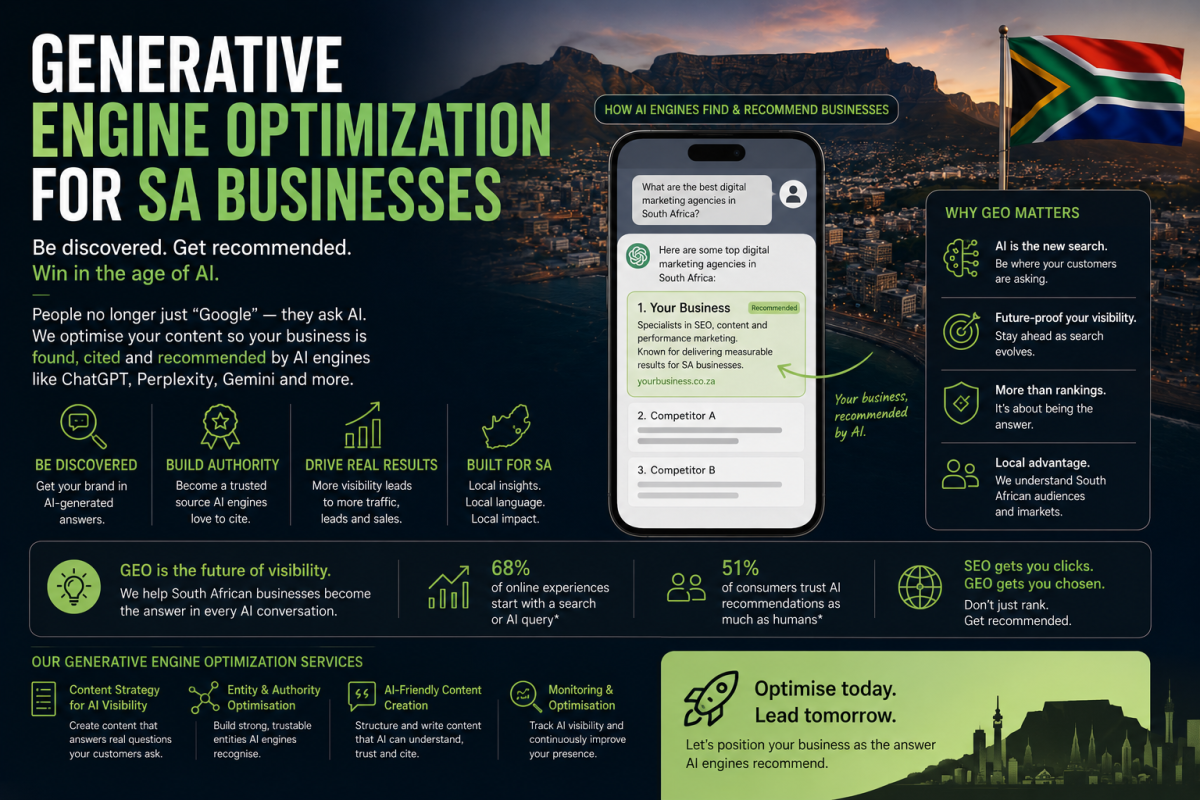
Generative Engine Optimization (GEO): How to Make Sure AI Recommends Your South African Business
For more than two decades, digital marketing has revolved around a single question:
"How do we rank higher on Google?"
Entire industries were built around answering that question.
Businesses invested heavily in:
- Search Engine Optimization (SEO)
- Content marketing
- Backlink building
- Technical website optimisation
- Keyword research
- Domain authority
The goal was simple.
When someone searched for a product or service, your business appeared first.
That model is now changing.
Not disappearing.
Changing.
A growing number of buyers are no longer starting their journey with a traditional search engine.
Instead, they are asking AI systems directly.
Questions that once went into Google are increasingly being asked inside AI platforms.
For example:
"Who are the best software development companies in Cape Town?"
"What CRM should a logistics company use in South Africa?"
"Who can build a WhatsApp Business API integration?"
"What are the best accounting firms for SMEs in the Western Cape?"
Instead of receiving ten blue links, users receive a direct answer.
Sometimes with recommendations.
Sometimes with summaries.
Sometimes with specific businesses mentioned by name.
This creates a completely new challenge.
How do you make sure AI recommends your company?
That is where Generative Engine Optimization, or GEO, enters the picture.
And for South African businesses, particularly in Cape Town, it may represent one of the biggest digital marketing opportunities of the next decade.
The Search Landscape Is Fragmenting
Historically, customer journeys were relatively predictable.
A prospect would:
- Open Google
- Search for a service
- Browse websites
- Compare options
- Make contact
Today, the process is becoming more fragmented.
Prospects may now begin with:
- AI assistants
- Chat-based search
- Voice assistants
- AI-powered browsers
- Large language models
- Recommendation engines
Instead of searching for information, people increasingly ask for conclusions.
That distinction is important.
Google traditionally returned documents.
AI increasingly returns answers.
And businesses that appear inside those answers gain a significant advantage.
What Is Generative Engine Optimization?
Generative Engine Optimization is the process of increasing the likelihood that AI systems will recognise, understand, trust, and recommend your business.
Traditional SEO focused on ranking webpages.
GEO focuses on influencing how AI models perceive and reference your brand.
The objective changes from:
"Rank number one."
To:
"Become a trusted entity AI systems understand and reference."
This requires a different mindset.
Because AI does not evaluate websites the same way humans do.
AI evaluates information ecosystems.
Why Traditional SEO Is No Longer Enough
Many businesses assume that strong SEO automatically translates into strong AI visibility.
Sometimes it does.
Often it does not.
A website might rank well in search results yet rarely appear in AI-generated recommendations.
Why?
Because AI systems evaluate signals beyond traditional rankings.
They look for:
- Brand consistency
- Trusted citations
- Entity recognition
- Structured data
- Contextual relevance
- Cross-platform validation
- Public references
- Topical authority
The strongest GEO strategies focus on building a complete digital footprint rather than simply ranking webpages.
The Rise of Entity-Based Search
One of the most important concepts in GEO is the idea of entities.
An entity is not merely a website.
It is a recognised thing.
Examples include:
- Companies
- People
- Products
- Locations
- Services
AI systems increasingly organise knowledge around entities.
The question is no longer:
"Does your website mention software development?"
The question becomes:
"Does the AI understand that your company is a software development firm with expertise in certain industries?"
Those are very different challenges.
Why AI Recommendations Matter
Consider how people increasingly interact with AI.
A business owner may ask:
"Who should build my logistics platform in South Africa?"
An executive may ask:
"Recommend a software company in Cape Town that specialises in automation."
A startup founder may ask:
"Which agencies understand AI integrations?"
If your company appears in those recommendations, you effectively skip several stages of the traditional marketing funnel.
You become part of the answer itself.
That is incredibly powerful.
The First-Mover Advantage Is Massive
One of the most exciting aspects of GEO is how early the market still is.
Most businesses remain focused entirely on traditional SEO.
Most agencies continue selling:
- Keyword optimisation
- Backlink campaigns
- Metadata improvements
- Content publishing
These remain valuable.
But very few agencies are actively optimising businesses for AI visibility.
This is particularly true in South Africa.
And even more true in Cape Town.
The businesses that start building GEO foundations today may gain years of advantage before competitors fully understand the shift.
Understanding How AI Finds Information
Many people imagine AI models simply reading websites.
The reality is more complex.
AI systems build understanding from many different sources.
These can include:
- Company websites
- Industry publications
- Business directories
- Knowledge graphs
- Public databases
- Press coverage
- Technical documentation
- Social profiles
- Review platforms
The more consistently your business appears across trusted sources, the stronger your digital identity becomes.
Consistency creates confidence.
Confidence increases recommendation potential.
Why Enterprise Schema Matters
One of the most practical GEO tools available today is structured data.
Structured data helps machines understand what your website actually represents.
Instead of guessing, AI systems receive explicit information.
Schema markup can communicate:
- Company name
- Industry
- Services
- Locations
- Founders
- Contact details
- Products
- Reviews
- Certifications
Think of schema as a translation layer.
It helps machines understand your business more accurately.
The clearer the information, the easier it becomes for AI systems to classify your organisation correctly.
Building a Strong Entity Profile
Many South African businesses have fragmented online identities.
For example:
The website says one thing.
LinkedIn says another.
A directory listing contains outdated information.
A Facebook page uses different descriptions.
This creates confusion.
AI systems prefer consistency.
Strong GEO begins with entity alignment.
Every major profile should consistently communicate:
- Business name
- Core services
- Industry positioning
- Geographic footprint
- Brand messaging
Consistency strengthens recognition.
Recognition improves recommendation potential.
Citations Are Becoming More Important Again
Many businesses associate citations with local SEO.
They remain critically important.
However, GEO expands the concept.
AI systems often validate businesses through multiple external references.
Examples include:
- Business directories
- Industry associations
- Chamber of commerce listings
- Review websites
- Media mentions
- Partner websites
Each mention acts as a trust signal.
The broader and more credible the citation network becomes, the stronger the entity profile becomes.
Unstructured Data Matters Too
Not all information lives inside neat databases.
Much of the internet is unstructured.
Articles.
Interviews.
Case studies.
Press releases.
Blog posts.
Industry discussions.
This content plays a major role in shaping AI understanding.
For example, if dozens of articles mention your company in connection with:
- Logistics software
- AI automation
- WhatsApp integration
AI systems begin associating your brand with those topics.
Over time, topical authority strengthens.
Content Is Still Critical—But Differently
Many businesses ask:
"Should we still create content?"
Absolutely.
But the purpose is evolving.
Traditional SEO content often focused on keywords.
Modern GEO content focuses on expertise.
Instead of producing generic articles, businesses should create content that demonstrates:
- Industry knowledge
- Technical capability
- Real-world experience
- Unique insights
AI systems increasingly reward depth over volume.
The goal is not merely being discoverable.
The goal is becoming cite-worthy.
The Importance of Industry-Specific Authority
AI recommendations become stronger when authority is focused.
A software company trying to be everything to everyone may struggle.
A software company consistently associated with:
- Logistics automation
- Financial technology
- AI integration
- Workflow systems
develops stronger topical authority.
Specificity matters.
The clearer your positioning, the easier it becomes for AI systems to understand where you belong.
How South African Businesses Can Prepare Today
Many GEO improvements do not require massive budgets.
Businesses can start by:
Standardising Brand Information
Ensure consistency across all digital properties.
Improving Structured Data
Implement enterprise-level schema markup.
Publishing Expert Content
Demonstrate genuine industry expertise.
Building Industry Citations
Increase references from trusted sources.
Strengthening Digital Authority
Create evidence of experience and capability.
Expanding Digital Footprints
Appear in more credible locations online.
Each step strengthens AI understanding.
The Cape Town Opportunity
Cape Town has developed a reputation as one of Africa's leading technology and innovation hubs.
Yet very few local agencies actively specialise in GEO.
Many still operate with SEO strategies designed for a search environment that is rapidly evolving.
This creates a significant opportunity.
Businesses that begin optimising for AI discovery today may establish dominant positions long before GEO becomes mainstream.
The competitive gap could become substantial.
Especially in professional services, software development, consulting, logistics, and B2B sectors.
GEO Is Not Replacing SEO
This is important.
Generative Engine Optimization is not replacing SEO.
SEO remains critical.
People still use Google.
People will continue using search engines.
The future is likely to be hybrid.
Businesses need both:
- Traditional discoverability
- AI discoverability
The strongest digital strategies combine both disciplines.
Strong SEO creates visibility.
Strong GEO creates recommendation potential.
Together, they create resilience.
Measuring GEO Success
Unlike traditional SEO, GEO is still developing measurement standards.
However, indicators may include:
- Increased AI citations
- Brand mentions in AI responses
- Higher direct traffic
- Increased branded searches
- Greater referral diversity
- Improved authority signals
The organisations that monitor these signals early will gain valuable insights into how AI ecosystems evolve.
The Future of Digital Marketing
The most important shift is not technological.
It is behavioural.
People increasingly want answers rather than lists.
They want recommendations rather than research.
They want conclusions rather than options.
AI systems are becoming the interface between businesses and customers.
This fundamentally changes how visibility works.
The brands that become trusted entities inside AI ecosystems will gain disproportionate exposure.
Those that ignore the shift may find themselves increasingly invisible.
What Leading Businesses Are Starting to Realise
The smartest companies are beginning to understand that visibility now exists on multiple layers.
There is:
- Search visibility
- Social visibility
- Marketplace visibility
- AI visibility
Each layer influences buying decisions.
Ignoring any one of them creates risk.
GEO represents the newest layer.
And perhaps the fastest-growing one.
Conclusion
For years, digital marketing focused almost exclusively on ranking websites inside traditional search engines.
That world is changing.
As buyers increasingly ask AI systems for recommendations, businesses must think beyond SEO and begin building visibility for generative engines as well.
Generative Engine Optimization focuses on helping AI systems understand, trust, and recommend your brand through structured data, entity development, trusted citations, topical authority, and consistent digital signals.
For South African businesses, the opportunity is particularly compelling because adoption remains extremely early. Very few agencies fully understand GEO, and even fewer are actively implementing it.
This creates a rare first-mover advantage.
The companies that begin building AI visibility today may become the businesses AI recommends tomorrow.
And in a world increasingly driven by intelligent assistants, being recommended may become even more valuable than being ranked.