
Enterprise Cloud Migration for SA Resiliency
14/06/2026
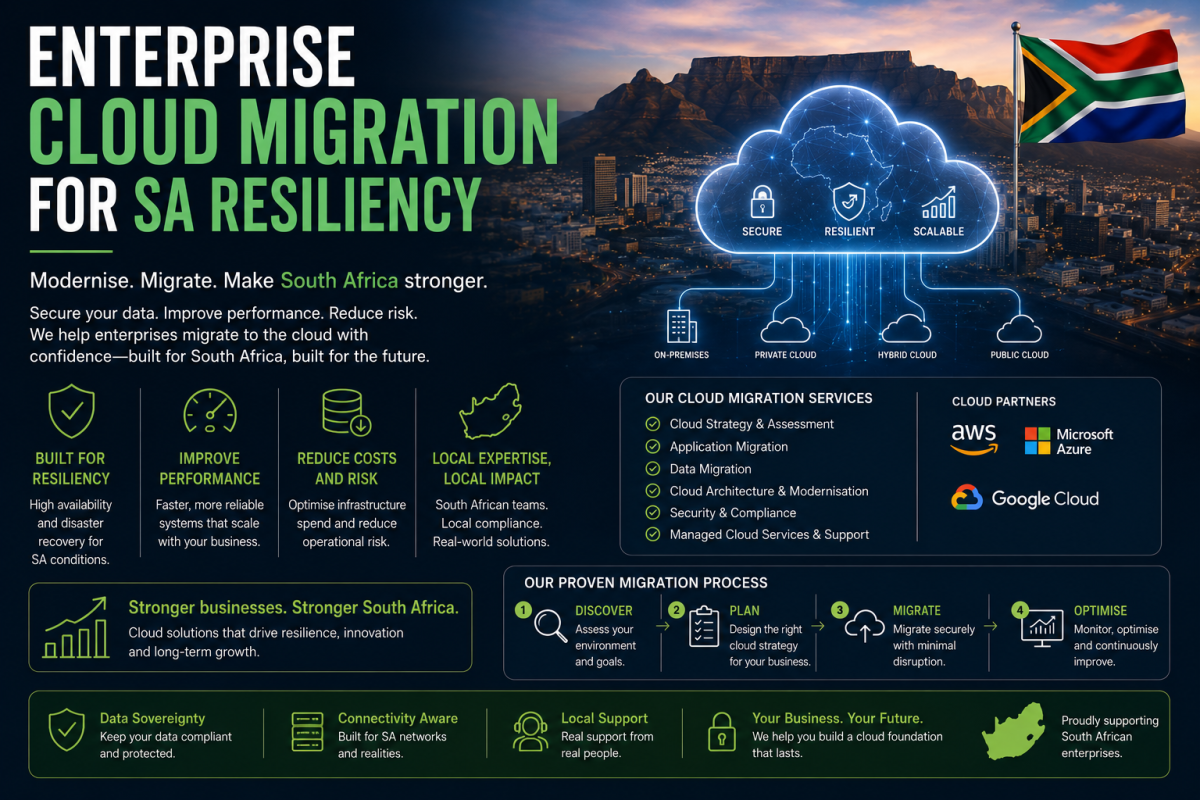
Building for Resilience: Why Enterprise Cloud Migration Is South Africa's Real Competitive Edge
For years, cloud computing was often viewed as a technology trend.
Businesses heard terms like:
- Cloud migration
- Digital transformation
- Infrastructure modernisation
- Cloud-native applications
Many executives assumed cloud adoption was primarily about technology teams upgrading systems.
Today, that perspective is changing.
Cloud migration is no longer simply an IT decision.
It is a business strategy decision.
It is a resilience decision.
It is a growth decision.
And increasingly, it is a competitive advantage.
Across South Africa, organisations are accelerating cloud adoption as they seek greater flexibility, stronger business continuity, improved scalability, and faster access to innovation.
The conversation is no longer:
"Should we move to the cloud?"
The conversation has become:
"How quickly can we modernise before our competitors do?"
This shift is particularly important as South African businesses navigate increasingly complex operating environments, growing customer expectations, rising cybersecurity requirements, and greater pressure to make smarter use of capital.
Cloud infrastructure is rapidly becoming one of the most important foundations of modern business resilience.
And the companies that embrace it effectively are positioning themselves for long-term success.
The Traditional Infrastructure Problem
Historically, businesses built their own infrastructure.
A growing company would purchase:
- Servers
- Networking equipment
- Storage systems
- Backup systems
- Security appliances
- Data centre space
Everything lived inside physical environments.
The model worked.
For many years, it was the only option.
However, this approach introduced several challenges.
Infrastructure required:
- Significant upfront investment
- Ongoing maintenance
- Hardware replacement cycles
- Specialist expertise
- Capacity forecasting
As businesses grew, complexity increased.
Technology teams spent substantial time managing infrastructure rather than enabling innovation.
The Capital Expenditure Trap
One of the biggest challenges of traditional infrastructure is capital expenditure.
Businesses often need to make large investments before they know exactly how much capacity they will require.
Imagine purchasing servers for the next five years.
Too much capacity creates waste.
Too little capacity creates bottlenecks.
Predicting future demand becomes difficult.
As markets become more dynamic, this challenge becomes even greater.
Cloud infrastructure changes the equation.
Moving from Capital Expenditure to Operational Expenditure
Cloud platforms introduced a fundamentally different model.
Instead of purchasing infrastructure outright, businesses consume resources as needed.
This transforms infrastructure spending from:
Capital Expenditure (CapEx)
Large upfront purchases.
To:
Operational Expenditure (OpEx)
Predictable monthly costs.
This shift provides several advantages.
Businesses gain:
- Greater flexibility
- Better cash flow management
- Improved forecasting
- Faster scaling
Infrastructure becomes more aligned with actual business demand.
Why Resilience Matters More Than Ever
Modern businesses operate in an environment where downtime carries significant consequences.
Customers expect services to be available continuously.
Operations increasingly depend on digital systems.
Data drives decision-making.
Applications support revenue generation.
Even short disruptions can create substantial costs.
Cloud migration addresses many of these challenges by improving resilience across critical systems.
Understanding Business Resilience
Business resilience refers to an organisation's ability to continue operating during disruptions.
Examples include:
- Hardware failures
- Network outages
- Cybersecurity incidents
- Natural disasters
- Human error
- Unexpected demand spikes
Traditional infrastructure often concentrates risk.
Cloud architectures distribute it.
This distinction becomes increasingly important as businesses become more digital.
Why South Africa Is Experiencing Accelerated Cloud Adoption
Several factors are driving cloud adoption across South Africa.
These include:
- Digital transformation initiatives
- Remote work requirements
- Data growth
- Security demands
- Customer expectations
- Analytics requirements
Businesses increasingly recognise that legacy infrastructure can become a constraint rather than an advantage.
Modern cloud platforms provide greater agility.
Agility creates competitive advantages.
The Evolution of Cloud Computing
Cloud adoption has evolved through several phases.
Cloud 1.0
Simple infrastructure migration.
Businesses moved servers into cloud environments.
Cloud 2.0
Cloud-native applications.
Organisations began redesigning systems specifically for cloud platforms.
Cloud 3.0
Multi-cloud, sovereign architectures, distributed resilience, and intelligent workload placement.
This is where many forward-thinking organisations are heading today.
What Is Cloud 3.0?
Cloud 3.0 represents a more mature approach to cloud computing.
Rather than relying on a single platform, organisations increasingly build architectures designed around flexibility and resilience.
Key characteristics include:
- Multi-cloud strategies
- Regional redundancy
- Sovereign data controls
- Distributed workloads
- Advanced automation
- Real-time analytics
The objective is not simply hosting applications.
The objective is building resilient digital ecosystems.
The Rise of Multi-Cloud Strategies
Many enterprises are moving beyond single-provider architectures.
Instead, they use multiple cloud platforms.
This approach reduces dependency on any one provider.
Benefits include:
- Improved resilience
- Reduced vendor risk
- Greater flexibility
- Optimised workloads
- Better geographic coverage
Multi-cloud strategies are becoming increasingly common among larger organisations.
Particularly those with mission-critical systems.
Understanding Sovereign Cloud Architecture
Data sovereignty has become an important topic globally.
Many organisations want greater control over:
- Data location
- Regulatory compliance
- Jurisdictional requirements
- Security policies
Sovereign cloud approaches help organisations maintain greater control while still benefiting from modern cloud infrastructure.
This is particularly relevant in regulated industries.
Why Local Infrastructure Changes Everything
One of the most significant developments for South African businesses has been the growth of local cloud infrastructure.
Historically, organisations often relied on infrastructure hosted thousands of kilometres away.
This introduced:
- Higher latency
- Increased complexity
- Regulatory concerns
- Data residency challenges
Local infrastructure changes the equation dramatically.
Businesses can now access enterprise-grade cloud services much closer to their customers and operations.
The Strategic Importance of Cape Town Infrastructure
The presence of world-class cloud infrastructure in Cape Town represents a major milestone for South Africa's digital economy.
Organisations gain access to:
- Lower latency
- Faster application performance
- Improved user experiences
- Better data residency options
- Enhanced resilience
These advantages benefit businesses across numerous industries.
Including:
- Financial services
- E-commerce
- Healthcare
- Logistics
- Manufacturing
- Professional services
Why Latency Matters
Latency refers to the time required for data to travel between systems.
Lower latency creates:
- Faster applications
- Better user experiences
- Improved responsiveness
- Smoother transactions
For customer-facing applications, even small improvements can significantly affect user satisfaction.
Local infrastructure helps minimise these delays.
Business Continuity as a Competitive Advantage
Many organisations treat disaster recovery as an insurance policy.
Modern cloud environments transform it into a competitive advantage.
Traditional disaster recovery often involved:
- Secondary hardware
- Backup sites
- Complex replication systems
Cloud platforms simplify many of these requirements.
Businesses can implement:
- Automated failover
- Geographic redundancy
- Real-time replication
- Continuous backups
The result is stronger operational resilience.
Real-Time Analytics Changes Decision Making
One of the most powerful cloud capabilities involves analytics.
Modern organisations generate enormous amounts of data.
The challenge is turning that data into actionable insights.
Cloud platforms enable:
- Real-time reporting
- Centralised analytics
- Cross-system visibility
- Faster decision-making
Executives gain access to information faster.
Operational teams respond more effectively.
Business performance improves.
The End of Data Silos
Many organisations struggle with fragmented information.
Data lives in:
- CRM systems
- ERP systems
- Marketing platforms
- Operational databases
- Financial applications
Cloud architectures help unify these environments.
Information becomes easier to access.
Reporting becomes more accurate.
Insights become more valuable.
Scaling Without Infrastructure Bottlenecks
Growth often creates technology challenges.
Traditional infrastructure must be planned years in advance.
Cloud environments scale more dynamically.
Businesses can rapidly increase:
- Computing resources
- Storage capacity
- Database performance
- Network throughput
This flexibility supports growth without requiring constant infrastructure investments.
Security Has Improved Dramatically
One common misconception is that cloud environments are inherently less secure.
In reality, many cloud platforms provide security capabilities beyond what most organisations could reasonably implement independently.
Examples include:
- Advanced monitoring
- Encryption
- Threat detection
- Identity management
- Automated patching
Security remains a shared responsibility.
But the available capabilities are often exceptionally robust.
Supporting Modern Application Development
Cloud migration also changes how software is built.
Development teams gain access to:
- Continuous deployment
- Automated testing
- Scalable environments
- Infrastructure automation
This accelerates innovation.
Products reach market faster.
Teams become more productive.
Why SMEs Benefit Too
Cloud advantages are not limited to large enterprises.
Small and medium-sized businesses often benefit significantly.
Cloud platforms provide access to enterprise-grade infrastructure without enterprise-level capital requirements.
This democratises technology.
Smaller organisations can compete more effectively.
The Hidden Cost of Delaying Migration
Many businesses postpone cloud initiatives because existing systems appear functional.
However, maintaining legacy infrastructure often creates hidden costs.
These include:
- Maintenance overhead
- Reduced agility
- Security risks
- Capacity limitations
- Innovation constraints
Over time, these costs accumulate.
Eventually, they can exceed migration costs.
Cloud Migration Is Not Simply a Technology Project
Successful migrations involve more than moving servers.
They require:
- Business alignment
- Process optimisation
- Security planning
- Governance frameworks
- Change management
The most successful organisations treat cloud migration as a business transformation initiative.
Not merely an infrastructure upgrade.
The South African Competitive Opportunity
South Africa occupies an increasingly interesting position within the global digital economy.
The combination of:
- Growing cloud infrastructure
- Strong technical talent
- Expanding connectivity
- Modern cloud platforms
creates significant opportunities.
Businesses that modernise early gain advantages in:
- Speed
- Resilience
- Innovation
- Cost efficiency
These advantages compound over time.
Why the Future Belongs to Resilient Organisations
Markets are becoming more dynamic.
Customer expectations are rising.
Technology cycles are accelerating.
The businesses that thrive will be those capable of adapting quickly.
Cloud infrastructure supports this adaptability.
It creates the foundation for:
- Continuous innovation
- Operational resilience
- Faster growth
- Better customer experiences
The technology itself is important.
The business outcomes are even more important.
The Potado Approach
At Potado, we view cloud migration as far more than an infrastructure exercise.
Modern cloud platforms provide opportunities to improve resilience, accelerate development, strengthen security, and create scalable foundations for long-term growth.
Our approach focuses on helping organisations move beyond basic cloud adoption toward modern architectures that prioritise availability, flexibility, analytics, and operational efficiency.
Whether through cloud-native application development, migration planning, multi-cloud strategies, or modern infrastructure design, the objective remains the same:
Create systems that support growth rather than constrain it.
Because the businesses that adapt fastest often become the businesses that lead their industries.
Conclusion
Cloud computing has evolved far beyond its original role as a hosting alternative. It has become one of the most important strategic tools available to modern organisations seeking resilience, agility, and long-term competitiveness.
Across South Africa, businesses are increasingly recognising that traditional infrastructure models often struggle to keep pace with modern demands. Large capital investments, rigid capacity planning, fragmented data systems, and operational complexity can all limit growth.
Cloud 3.0 architectures offer a different path. Through multi-cloud strategies, sovereign data approaches, local infrastructure, real-time analytics, and scalable operational models, organisations gain the flexibility required to thrive in rapidly changing markets.
The growing availability of world-class cloud infrastructure in Cape Town further strengthens this opportunity, providing businesses with lower latency, improved resilience, stronger data governance options, and better customer experiences.
Ultimately, cloud migration is not about servers.
It is about resilience.
It is about agility.
It is about building organisations capable of adapting, innovating, and growing regardless of what challenges emerge next.
And in an increasingly digital economy, that resilience may become South Africa's most important competitive advantage.