
How Much Does It Cost To Develop An App In South Africa?
04/01/2026
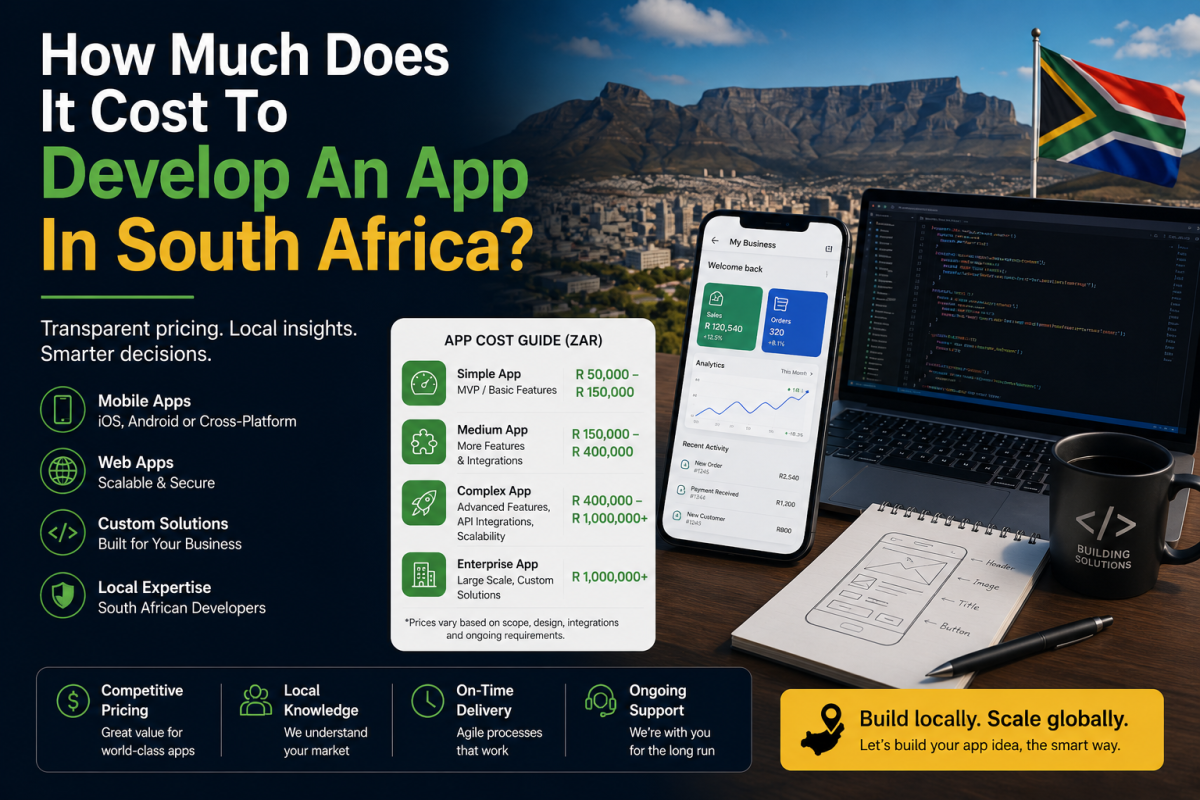
Mobile apps have become an important part of how South Africans bank, shop, book services, manage businesses, communicate with customers, and access digital products. From ecommerce and fintech to healthcare, logistics, education, property, and internal business tools, apps are no longer only for large technology companies.
For startups and established businesses, one of the first questions is usually the same: how much does it cost to develop an app in South Africa?
The short answer is that app development in South Africa can cost anywhere from R80,000 to R2,500,000+, depending on the complexity of the app, the platforms required, the features involved, and the quality of the development team.
A simple app may cost between R80,000 and R250,000. A more advanced customer-facing app may cost between R250,000 and R900,000. A complex marketplace, fintech app, logistics platform, or enterprise system can easily exceed R1,000,000.
These figures are broad estimates, but they provide a realistic starting point for budgeting an app project in South Africa.
App Development Costs in South Africa by Complexity
App development pricing is usually linked to time. The more planning, design, development, testing, and integration required, the higher the cost.
Simple Apps: R80,000 to R250,000
Simple apps usually have a limited number of features and a straightforward user experience.
Examples include:
- Informational apps
- Simple booking apps
- Basic calculators
- Event apps
- Basic loyalty apps
- Simple internal tools
- Simple content-based apps
These apps may include basic screens, simple user interactions, static content, contact forms, and limited backend functionality.
A simple app is often suitable for businesses that need a digital tool for a narrow purpose rather than a full-scale platform.
Moderate Apps: R250,000 to R900,000
Moderate apps include more advanced features, better design, user accounts, databases, integrations, and more complex workflows.
Examples include:
- Ecommerce apps
- Fitness apps
- Customer portals
- Booking platforms
- Delivery apps
- Property listing apps
- Membership apps
- Education apps
These apps often require a backend system, admin dashboard, payment integration, push notifications, user profiles, and analytics.
For many South African startups and SMEs, this is the most common app development range.
Complex Apps: R900,000 to R2,500,000+
Complex apps require advanced functionality, high scalability, strong security, multiple user roles, third-party integrations, and ongoing development.
Examples include:
- Marketplace apps
- Fintech platforms
- Logistics platforms
- Healthcare systems
- On-demand service apps
- Enterprise management systems
- SaaS platforms
- Apps with AI, geolocation, or complex automation
These projects require a larger team and longer development timelines. They often involve product strategy, UI/UX design, backend architecture, API development, mobile development, testing, deployment, and ongoing maintenance.
App Development Costs by Platform
The platform you choose has a major impact on cost.
Web App Development: R100,000 to R700,000
A web app runs in a browser and can be accessed from desktops, tablets, and mobile phones.
Web apps are often more cost-effective than native mobile apps because they do not require separate development for iOS and Android.
Examples include:
- Internal dashboards
- Client portals
- Admin systems
- Booking platforms
- SaaS tools
- CRM systems
- Business management apps
A web app is often the best option when your users do not specifically need an app from the App Store or Google Play.
For many businesses in South Africa, a well-built web app is the most practical and cost-effective starting point.
Native Mobile App Development: R300,000 to R1,500,000+
Native apps are built specifically for iOS or Android.
An iOS app is usually built using Swift, while an Android app is typically built using Kotlin or Java.
Native apps offer strong performance and access to device-specific features such as:
- Camera
- GPS
- Bluetooth
- Biometrics
- Push notifications
- Offline functionality
- Device sensors
However, native app development is more expensive because separate codebases may be required for iOS and Android.
Native development is usually best for apps where performance, device integration, or user experience is extremely important.
Cross-Platform App Development: R200,000 to R1,200,000
Cross-platform app development allows one codebase to run on both iOS and Android.
Popular frameworks include Flutter and React Native.
Cross-platform development can reduce costs compared to fully native development because the same development team can build for multiple platforms more efficiently.
This is often the best option for South African startups and businesses that need both Android and iOS apps without doubling the development budget.
Hybrid App Development: R150,000 to R700,000
Hybrid apps use web technologies inside a mobile app wrapper.
They can be more affordable than native apps, but may not offer the same performance or user experience.
Hybrid apps can work well for simpler apps, internal tools, and content-heavy applications where advanced mobile performance is not required.
MVP vs Full Product App Development Costs in South Africa
One of the best ways to manage app development costs is to start with an MVP.
MVP App Development: R120,000 to R500,000
An MVP, or Minimum Viable Product, is the first functional version of your app.
It includes only the core features required to test the idea, launch quickly, and gather feedback from real users.
An MVP is useful because it helps you avoid spending too much money on features users may not actually need.
A South African app MVP may include:
- User registration
- Core app screens
- Basic admin dashboard
- Payment integration
- Basic database
- Simple notifications
- Essential user flows
For startups, MVP development is usually the smartest approach because it reduces risk and allows the product to improve based on real market feedback.
Full Product Development: R500,000 to R2,500,000+
A full product includes a more complete feature set, polished design, advanced functionality, scalability, analytics, integrations, and a more robust backend.
This is suitable for businesses that already have a validated idea, existing customer base, or clear commercial use case.
A full product may include:
- Advanced user roles
- Admin dashboards
- Payment systems
- Real-time messaging
- API integrations
- Reporting tools
- Security features
- Multi-platform support
- Advanced analytics
- Automation workflows
A full product costs more, but it can also deliver far more value when the business model is already proven.
Factors That Affect App Development Costs in South Africa
Strategy and Consulting
Some app development companies simply build what the client requests.
Others help shape the product strategy.
A stronger development partner will help you answer important questions before writing code:
- Who is the app for?
- What problem does it solve?
- Which features are essential?
- What should be included in version one?
- How will the app make money?
- What technology should be used?
- How will the app scale?
This strategic input can increase the upfront cost, but it often saves money by preventing poor product decisions.
Wireframing and Prototyping
Wireframes and prototypes help define how the app will work before development begins.
This stage usually includes:
- User journey planning
- Screen layouts
- Feature mapping
- Clickable prototypes
- User flow design
Skipping this stage can lead to confusion, delays, and expensive changes later in the project.
For a serious app, wireframing and prototyping may cost between R30,000 and R150,000, depending on complexity.
UI and UX Design
Good design is not only about how the app looks. It affects how easily users can understand and use the product.
A poorly designed app may technically work but still fail because users find it confusing.
Professional UI and UX design can cost between R50,000 and R300,000+ depending on the number of screens, design complexity, and level of research required.
Apps with custom illustrations, animations, dashboards, complex user journeys, or multiple user types will cost more to design.
Features and Functionality
Features are one of the biggest cost drivers.
Simple features may be quick to build, while complex features can take weeks or months.
Common app features include:
- User registration
- Login and authentication
- User profiles
- Admin dashboards
- Payments
- Push notifications
- Maps and geolocation
- Messaging
- Ratings and reviews
- File uploads
- Search and filtering
- Analytics
- In-app purchases
- Subscriptions
A payment integration may be straightforward. A marketplace payment system with commissions, refunds, wallets, and multiple vendors is much more complex.
The more features your app has, the more expensive it becomes.
Backend and Database Requirements
Most serious apps need a backend.
The backend stores data, manages users, handles permissions, processes transactions, and connects the app to other systems.
Backend complexity depends on what the app needs to do.
A simple backend may use Firebase or Supabase to reduce development time. A larger platform may require a custom backend using technologies such as Node.js, Laravel, Django, PostgreSQL, MySQL, or MongoDB.
A basic backend may cost R50,000 to R200,000.
A complex backend can cost R300,000 to R1,000,000+.
External APIs and Integrations
Many apps rely on third-party services.
Examples include:
- Payment gateways
- SMS providers
- Email services
- Maps
- Analytics
- CRM systems
- Accounting software
- KYC verification
- Delivery tracking
- WhatsApp messaging
- AI tools
Each integration adds time, complexity, testing, and sometimes monthly usage costs.
In South Africa, payment integrations, SMS costs, and verification services should be considered carefully because they can affect both development and ongoing operating costs.
Security and Compliance
Security becomes more important when an app handles personal information, financial data, healthcare information, or business-critical records.
Security-related development may include:
- Secure authentication
- Password encryption
- Access controls
- Audit logs
- Data protection
- Secure APIs
- Permission management
- POPIA considerations
Apps in fintech, healthcare, legal, insurance, and enterprise environments usually require stronger security measures, which increases development time and cost.
Speed and Timeline
If you need an app built quickly, it may cost more.
A shorter deadline may require:
- More developers
- More project management
- Faster design cycles
- Parallel development
- More intensive testing
A realistic timeline for a simple MVP may be 8 to 12 weeks.
A moderate app may take 3 to 6 months.
A complex platform may take 6 to 12 months or longer.
Trying to rush development can lead to bugs, poor user experience, and higher long-term costs.
Location and Expertise
App development costs vary depending on the team you hire.
In South Africa, app development rates often range from R600 to R1,500+ per hour, depending on experience, seniority, and specialisation.
A junior developer may cost less, while a senior mobile developer, product strategist, UX designer, or AI engineer will cost more.
A typical app development team may include:
- Project manager
- Product strategist
- UI/UX designer
- Frontend developer
- Backend developer
- Mobile developer
- QA tester
- DevOps engineer
The more specialised the team, the higher the cost, but also the better the chance of producing a reliable, scalable app.
Types of Apps and What They Cost in South Africa
Informational Apps: R80,000 to R300,000


Informational apps present content, resources, schedules, menus, guides, or business information in a structured mobile format.
Examples include:
- Event apps
- Restaurant menu apps
- Tourism guide apps
- School information apps
- Conference apps
- Business directory apps
These apps are usually more affordable because they require fewer complex features.
However, costs can increase if the app includes content management, offline access, push notifications, or user accounts.
Ecommerce Apps: R200,000 to R800,000

Ecommerce apps allow businesses to sell products directly to customers.
A South African ecommerce app may include:
- Product listings
- Search and filters
- Shopping cart
- Payment integration
- Delivery options
- Customer accounts
- Promotions
- Order tracking
An app similar in concept to Takealot or a store-specific shopping app would require strong product management, payments, logistics, and backend systems.
For smaller retailers, it may be more cost-effective to start with a web-based ecommerce store before building a full mobile app.
Marketplace Apps: R400,000 to R2,000,000+

Marketplace apps connect buyers and sellers, customers and service providers, or two different user groups.
Examples include:
- Property marketplaces
- Freelance marketplaces
- Delivery platforms
- Home services apps
- Booking platforms
- Rental marketplaces
Marketplace apps are more expensive because they usually require:
- Multiple user roles
- Vendor dashboards
- Customer accounts
- Payments
- Commission logic
- Reviews
- Messaging
- Dispute handling
- Admin management
A marketplace app is rarely simple. Even an MVP can become expensive if too many features are included at launch.
Social Apps: R300,000 to R1,500,000+

Social apps allow users to create accounts, share content, communicate, follow others, or participate in communities.
Features may include:
- Profiles
- Feeds
- Messaging
- Comments
- Likes
- Media uploads
- Notifications
- Moderation tools
Social apps can become expensive because they require real-time interactions, strong backend infrastructure, content moderation, and scalable architecture.
For most startups, it is better to start with a narrow community or niche use case rather than trying to build a large social platform immediately.
Productivity Apps: R100,000 to R500,000

Productivity apps help users manage tasks, time, notes, files, projects, or workflows.
Examples include:
- Task management apps
- Calendar apps
- Habit trackers
- Note-taking apps
- Project management tools
- Personal finance tools
Costs depend on whether the app is single-user or collaborative.
A simple productivity app may be relatively affordable. A collaborative project management app with teams, permissions, file storage, and notifications will cost significantly more.
Business Management Apps: R300,000 to R2,500,000+

Business management apps are internal tools that help companies improve operations.
These may include:
- CRM systems
- Staff management apps
- Inventory tools
- Logistics tracking
- Field service apps
- Reporting dashboards
- HR systems
- Client portals
- Workflow automation tools
These apps can deliver a strong return on investment because they save time, reduce errors, and improve business efficiency.
For many South African businesses, a custom internal tool can be more valuable than a customer-facing app.
App Development Costs by South African Example
App Like Takealot: R800,000 to R3,000,000+
An app similar to Takealot requires product listings, search, user accounts, cart functionality, payments, order management, logistics, reviews, promotions, and a powerful admin backend.
A smaller ecommerce MVP may cost far less, but a serious multi-category ecommerce platform requires a large budget.
App Like SweepSouth: R700,000 to R2,500,000+
An on-demand service app like SweepSouth requires customer accounts, service provider accounts, booking logic, calendars, payments, ratings, location features, and admin tools.
The complexity comes from matching users with providers and managing the service workflow.
App Like SnapScan or Zapper: R900,000 to R3,000,000+
Payment apps require strong security, transaction processing, merchant tools, QR code functionality, transaction history, compliance considerations, and reliable backend infrastructure.
Fintech apps are usually more expensive because security and reliability are critical.
App Like Vula Mobile: R700,000 to R2,500,000+
Healthcare apps require careful design, secure messaging, user roles, referrals, patient-related data, appointment workflows, and privacy considerations.
Apps in healthcare must be built with strong attention to security, usability, and reliability.
Ongoing App Maintenance Costs
App development does not end at launch.
After your app goes live, you should budget for maintenance, updates, hosting, bug fixes, security patches, and improvements.
Typical ongoing costs may include:
- Hosting
- Database usage
- API costs
- App store updates
- Bug fixes
- Feature improvements
- Security monitoring
- Analytics
- Customer support tools
A realistic maintenance budget is usually 10% to 25% of the initial development cost per year.
For example, if your app costs R500,000 to build, you may need to budget R50,000 to R125,000 per year for maintenance and improvements.
For active apps, monthly retainers may range from R10,000 to R80,000+, depending on support needs.
How to Reduce App Development Costs
The best way to reduce app development costs is not to choose the cheapest developer.
The best approach is to reduce unnecessary complexity.
Start with an MVP
Build the simplest version that solves the main problem.
Prioritise Core Features
Avoid adding every possible feature to version one.
Use Cross-Platform Development
Frameworks like Flutter and React Native can reduce costs for many projects.
Use Existing Tools Where Possible
Not every feature needs to be custom-built.
Using existing payment gateways, authentication tools, databases, and APIs can reduce development time.
Plan Properly Before Development
Good planning reduces expensive changes later.
Build in Phases
Launch version one, test the market, then improve based on user feedback.
Working with an App Development Company in South Africa
The cost of developing an app in South Africa depends on your goals, features, platforms, design requirements, development team, and long-term product vision.
A simple app may cost under R250,000, while a serious business platform can cost well over R1,000,000.
The most important thing is to work with an app development company that can help you make smart product decisions, not just write code.
A good development partner should help you:
- Define the product strategy
- Prioritise features
- Choose the right technology
- Reduce unnecessary costs
- Design a better user experience
- Build a scalable foundation
- Launch in phases
- Improve the app over time
For most businesses and startups, the best approach is to start with a focused MVP, validate the idea, and then expand based on real user feedback.
App development can be a significant investment, but when done properly, it can become a valuable business asset that improves customer experience, increases revenue, reduces operational costs, and creates new growth opportunities.
If you are planning to develop an app in South Africa, Potado can help you turn your idea into a practical, scalable, and commercially viable product.