
Deploying Agentic AI in South African Businesses
01/06/2026
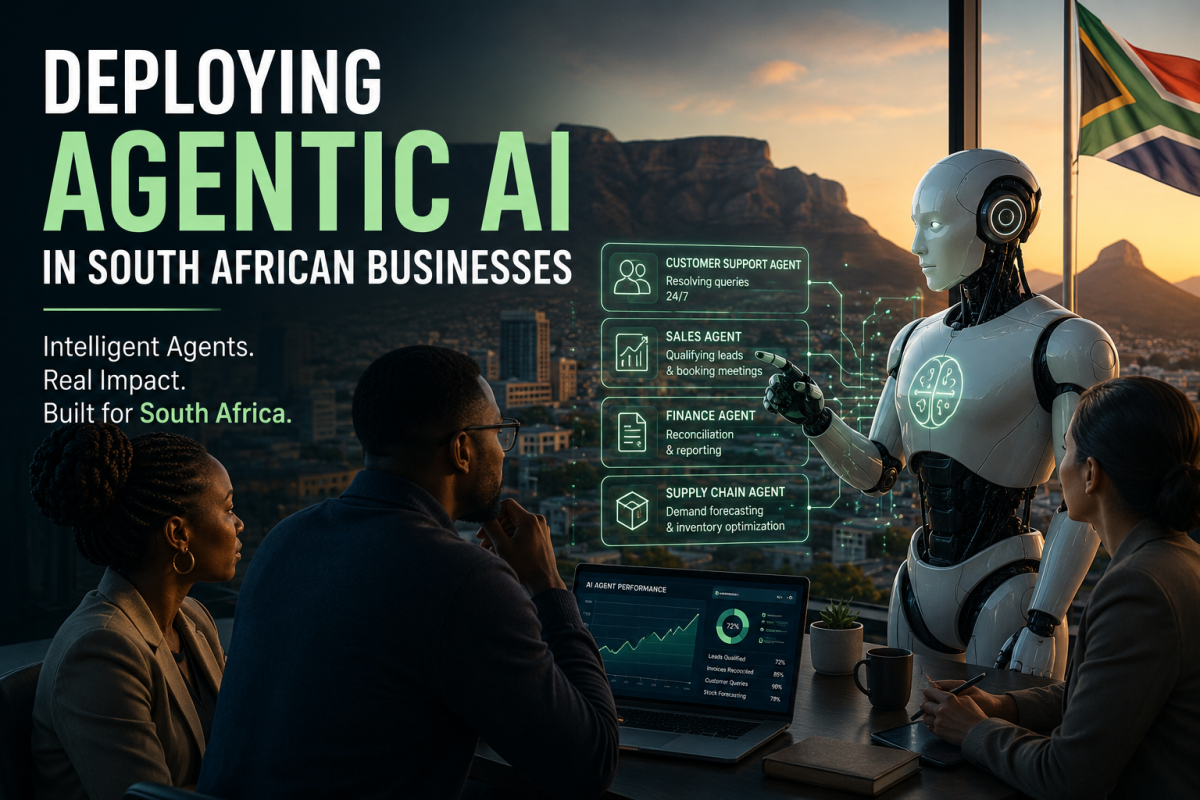
From Chatbots to Action: Deploying Agentic AI in South African Operations
The End of the Chatbot Era
For the past few years, businesses across South Africa have been experimenting with artificial intelligence. Most of these efforts focused on chatbots—digital assistants that could answer customer questions, generate text, or provide basic support.
While chatbots represented an important first step, many organisations are beginning to realise their limitations.
A chatbot can answer a question.
A chatbot can draft an email.
A chatbot can explain a process.
But after providing information, the work still falls back to a human employee.
The next evolution of artificial intelligence is changing that reality.
Welcome to the age of Agentic AI.
Unlike traditional AI systems that simply provide responses, Agentic AI systems can take action. They can perform tasks, make decisions within defined parameters, interact with business software, and complete entire workflows from start to finish.
For South African companies facing rising operational costs, increasing competition, and pressure to improve productivity without significantly increasing headcount, Agentic AI represents one of the most important technology opportunities of the decade.
The question is no longer whether AI can assist employees.
The question is whether AI can become a productive digital worker inside the organisation.
What Exactly Is Agentic AI?
The simplest way to understand Agentic AI is to compare it to a traditional chatbot.
Traditional Chatbot
A supplier sends an invoice.
An employee uploads it into a chatbot and asks:
"Can you extract the invoice details?"
The chatbot extracts the information.
The employee then:
- Checks the data
- Opens the accounting system
- Creates the invoice entry
- Matches it to the purchase order
- Flags any discrepancies
- Routes it for approval
The chatbot helped.
The employee still did the work.
Agentic AI
The supplier sends an invoice.
An AI agent automatically:
- Reads the invoice
- Extracts relevant information
- Matches it against purchase orders
- Verifies pricing
- Checks payment terms
- Flags exceptions
- Creates accounting entries
- Routes approvals
- Updates reporting dashboards
- Notifies relevant stakeholders
The employee only reviews unusual cases.
The AI completes the routine work.
This is the fundamental difference.
Chatbots provide information.
Agentic AI executes processes.
Why South African Businesses Should Pay Attention
Many South African organisations have spent years attempting to improve operational efficiency.
The challenge is that a large percentage of administrative work remains heavily manual.
Examples include:
- Invoice processing
- Data capture
- CRM updates
- Customer onboarding
- Compliance checks
- Vendor management
- Reporting
- Internal approvals
- Contract administration
- Email triage
These processes often involve employees copying information between systems, updating spreadsheets, forwarding emails, and performing repetitive checks.
None of these activities directly create value for customers.
Yet they consume thousands of work hours every month.
Agentic AI targets exactly these bottlenecks.
Rather than replacing employees, it removes low-value administrative work so employees can focus on activities that generate revenue, strengthen customer relationships, and solve complex business problems.
In a country where businesses must carefully manage labour costs while remaining globally competitive, this distinction is important.
The goal is not fewer people.
The goal is more productive people.
The Hidden Cost of Administrative Work
Many executives underestimate how much time their teams spend on administration.
Consider a typical corporate environment.
Employees might spend significant portions of their day:
- Reading emails
- Updating customer records
- Chasing approvals
- Generating reports
- Capturing data
- Verifying documents
- Following up on requests
- Updating project systems
Each individual task may only take a few minutes.
Combined across dozens or hundreds of employees, they become a massive operational cost.
A company with 100 administrative employees may effectively lose thousands of productive hours every month to routine process work.
Agentic AI creates an opportunity to reclaim those hours.
Agentic AI in Finance Operations
Finance departments are among the most obvious candidates for AI agent deployment.
Many accounting processes are highly structured and rule-based.
Examples include:
Accounts Payable
An AI agent can:
- Receive supplier invoices
- Extract information automatically
- Verify supplier details
- Match invoices to purchase orders
- Flag discrepancies
- Route approvals
- Schedule payments
Instead of employees processing every invoice manually, they focus only on exceptions.
Expense Management
Employees submit expenses.
An AI agent:
- Reviews receipts
- Checks policy compliance
- Categorises expenses
- Flags violations
- Approves low-risk claims automatically
Finance teams spend less time reviewing routine submissions.
Month-End Reconciliation
One of the most time-consuming finance activities is reconciliation.
AI agents can:
- Compare transactions
- Match records
- Identify discrepancies
- Suggest corrections
- Produce reconciliation reports
Tasks that previously required days may be completed in hours.
Transforming Customer Relationship Management
Many organisations invest heavily in CRM platforms.
Unfortunately, CRM systems often become outdated because employees fail to update them consistently.
The problem is not the software.
The problem is the administrative burden.
Agentic AI can solve this.
Imagine a sales representative receives dozens of client emails daily.
An AI agent can:
- Read incoming communications
- Identify customer requests
- Update CRM records
- Create tasks
- Schedule follow-ups
- Log meeting notes
- Track opportunities
The salesperson focuses on building relationships and closing deals.
The AI handles the administrative workload.
This creates cleaner data and better visibility across the business.
Enhancing Customer Service Operations
Customer service teams often face growing workloads without corresponding increases in staffing.
Traditional chatbots helped answer simple questions.
Agentic AI goes much further.
Consider a customer requesting a contract amendment.
Instead of merely directing the customer to a support agent, an AI agent can:
- Verify customer identity
- Retrieve account information
- Review contract terms
- Generate amendment documents
- Route approvals
- Update systems
- Confirm completion
The customer receives faster service.
Employees handle fewer routine requests.
Operational efficiency improves significantly.
Human Resources and Employee Administration
HR departments frequently manage large volumes of repetitive administrative work.
Examples include:
- Leave requests
- Employee onboarding
- Policy acknowledgements
- Compliance training
- Document management
- Benefits administration
Agentic AI can automate much of this activity.
For example, onboarding a new employee often involves multiple systems and departments.
An AI agent can:
- Collect required documentation
- Verify information
- Create user accounts
- Schedule training
- Prepare contracts
- Notify managers
- Track completion status
Instead of coordinating dozens of manual steps, HR teams oversee the process.
Procurement and Supply Chain Opportunities
South African businesses continue to face supply chain challenges, making operational efficiency increasingly important.
Procurement processes often involve:
- Supplier communication
- Quote collection
- Approval workflows
- Contract management
- Order tracking
AI agents can coordinate these activities automatically.
For example, when inventory reaches a defined threshold, an AI agent could:
- Identify approved suppliers
- Request quotations
- Compare pricing
- Recommend selections
- Generate purchase orders
- Track delivery status
Human managers remain responsible for strategic decisions.
The AI handles execution.
Working with Legacy Systems
One common misconception is that Agentic AI requires a complete technology overhaul.
Many South African organisations still rely on older systems.
This is particularly true in sectors such as:
- Manufacturing
- Logistics
- Financial services
- Healthcare
- Professional services
Fortunately, modern AI agents can often integrate with existing environments.
They can interact with:
- ERP platforms
- Accounting software
- CRM systems
- Email platforms
- Document repositories
- Internal databases
Rather than replacing legacy infrastructure, AI agents frequently sit on top of existing systems and coordinate workflows between them.
This significantly reduces implementation risk.
Why Agentic AI Matters More Than Traditional Automation
Businesses have used automation tools for decades.
So what makes Agentic AI different?
Traditional automation requires predefined rules.
For example:
If invoice amount is below R10,000, send to Manager A.
These systems work well for predictable scenarios.
However, they struggle when situations become more complex.
Agentic AI introduces reasoning.
It can:
- Understand context
- Interpret unstructured information
- Make recommendations
- Adapt to changing situations
- Handle exceptions
This flexibility allows businesses to automate processes that were previously considered too complex.
Freeing Employees for Higher-Value Work
One of the most important benefits of Agentic AI is often overlooked.
It is not merely about reducing workload.
It is about reallocating talent.
South African businesses invest heavily in recruiting, training, and retaining skilled employees.
Yet many of these employees spend large portions of their day on repetitive tasks.
Examples include:
- Data entry
- Report preparation
- Information gathering
- Internal coordination
- Status updates
These activities rarely utilise the full capabilities of experienced professionals.
Agentic AI allows organisations to redirect employees toward:
- Client engagement
- Business development
- Strategic planning
- Problem solving
- Innovation
- Relationship management
These are the activities that create competitive advantage.
The Competitive Advantage for South African Firms
South African companies increasingly compete in global markets.
Clients compare service quality, responsiveness, and operational efficiency against international standards.
Businesses that deploy Agentic AI effectively can gain several advantages:
Faster Response Times
Requests are processed immediately rather than waiting in queues.
Lower Operational Costs
Routine work requires fewer manual interventions.
Improved Accuracy
AI agents reduce human data entry errors.
Better Customer Experience
Processes move faster and more consistently.
Greater Scalability
Organisations can handle increased workloads without proportional increases in staffing.
These advantages become increasingly important as competition intensifies.
Common Implementation Mistakes
Despite the opportunities, many organisations approach AI incorrectly.
A common mistake is attempting to automate everything at once.
Successful deployments usually begin with a single process.
Examples include:
- Invoice processing
- CRM updates
- Employee onboarding
- Support ticket routing
Once success is demonstrated, organisations expand gradually.
Another mistake is focusing solely on technology.
Agentic AI projects succeed when businesses redesign workflows around outcomes rather than existing procedures.
Simply adding AI to a broken process rarely delivers meaningful results.
Governance and Human Oversight
Agentic AI does not eliminate the need for human supervision.
Businesses must establish clear governance frameworks.
Key considerations include:
- Approval thresholds
- Audit trails
- Security controls
- Compliance requirements
- Escalation procedures
The most effective implementations use a "human-in-the-loop" approach.
The AI manages routine work.
Humans review high-risk decisions.
This combination delivers efficiency while maintaining accountability.
A Practical Starting Point
For organisations considering Agentic AI, the best starting point is identifying a process that meets three criteria:
High Volume
The process occurs frequently.
Rule-Based
There are clear business rules.
Administrative
The work consumes employee time without directly creating customer value.
These processes typically generate the fastest return on investment.
Examples include:
- Invoice approvals
- CRM maintenance
- Email classification
- Document processing
- Reporting workflows
Starting small allows businesses to learn, refine, and scale successfully.
The Future of Work in South Africa
The conversation around AI often focuses on job replacement.
In reality, many South African organisations face a different challenge.
They need to improve productivity, service quality, and operational efficiency while managing costs.
Agentic AI offers a practical solution.
By automating administrative bottlenecks, businesses can unlock the capacity of their existing teams.
Employees spend less time moving information between systems.
They spend more time serving customers, building relationships, solving problems, and growing the business.
The result is not simply a more automated organisation.
It is a more effective one.
Conclusion
The era of the chatbot is rapidly giving way to something far more powerful.
Agentic AI moves beyond answering questions and generating content. It executes business processes, coordinates workflows, interacts with enterprise systems, and completes tasks with minimal human intervention.
For South African organisations, the opportunity is particularly significant.
Many businesses continue to operate with administrative processes that consume thousands of hours of employee time each month. Agentic AI provides a path to remove these bottlenecks without necessarily increasing headcount or replacing existing technology investments.
The companies that embrace this shift will not simply work faster. They will free their people to focus on the activities that matter most—serving clients, driving growth, and creating value.
In the coming years, the most successful organisations may not be those with the largest teams.
They may be those with the most effective combination of human expertise and intelligent digital agents.